

Hear the Conversation | Get the Book
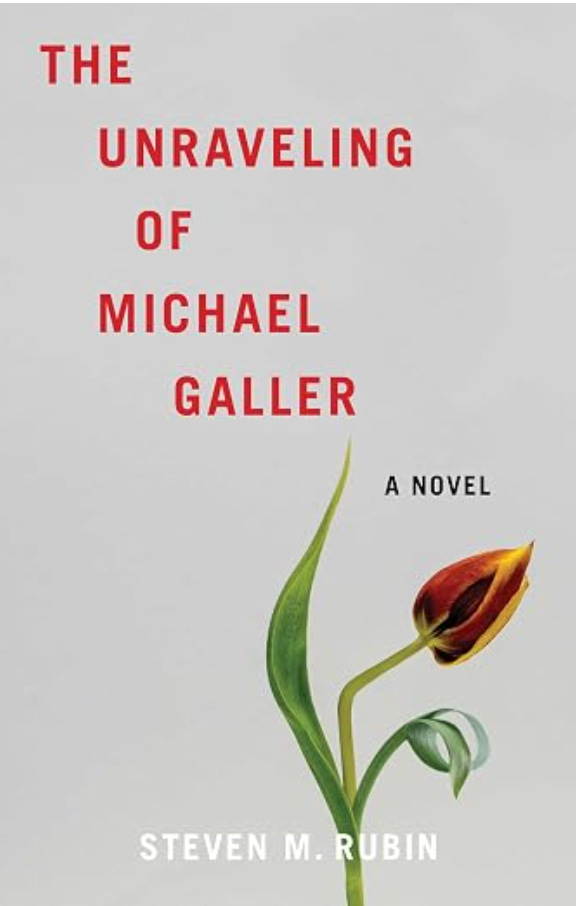
Steven Rubin’s The Unraveling of Michael Galler begins not with a monster in the room but with an absence. Michael is eight years old when his mother dies of cancer. From that point forward the world becomes a place where invisible things gather strength in silence. Childhood, Steven tells me, is not merely a landscape of baseball gloves, schoolbooks, and family dinners. It is a laboratory in which grief becomes theory. And theory becomes fate.
Steven resists calling the story an autobiography, though the book borrows from his own life. He, too, lost his mother to cancer as a child. He, too, grew up in the orbit of family illness and athletic discipline. He ran marathons, including one that ended, rather dramatically, in a heart attack at the halfway point. Five years later, with medical blessing and a stubbornness that could be the epilogue to a thriller, he returned and finished what he had started. That story becomes a key to understanding Steven’s fiction. For him, endurance is never simply physical. The body runs. The mind keeps score.
Michael Galler is a gifted teenager, diligent, athletic, and outwardly admirable. He excels in school. He trains for the Boston Marathon. He loves his widowed father and feels a fierce responsibility toward his younger brother. Yet beneath this discipline is a dread so private and so consuming that it begins to change shape. In Michael’s mind, cancer ceases to be a medical diagnosis. It becomes a category of existence. It is any threat that forms unseen, any force that grows without permission, any bad thing waiting inside the body or the family or the future.
This is the novel’s unsettling invention. Steven does not need to make Michael’s fear rational. He needs only to make us believe that Michael believes it. The result is not a conventional thriller but a slow psychological family drama. The suspense lies less in what happens than in how a young mind explains what happens. Each adult consolation, each family injury, each new anxiety becomes evidence in Michael’s private case against the universe.
The marathon, then, is more than a race. It is Michael’s crucible, the point at which discipline and delusion become almost indistinguishable. To train the body is to fortify the self. To finish the distance is to prove that the unseen enemy can be held at bay. Steven understands the seduction of that idea. He is also viscerally aware of its danger. A goal can save a person. It can also narrow the world until nothing remains but the goal.
What gives the novel emotional weight is Michael’s tenderness, especially toward his brother. His protectiveness may become distorted, but it begins in love. Steven’s darker turns are anchored by that fact. Michael is not a case study. He is a boy trying to build armor out of grief.
Steven says that ideas can grow in the mind and carry us to places we never intended to go. The Unraveling of Michael Galler is about that growth, that feeding, that terrible intimacy between imagination and fear. It is also about writing itself, which Steven Rubin likens, inevitably and correctly, to a marathon. You begin with a private distance. You continue because something inside you insists. And somewhere near the end, if you are fortunate, you discover where your marathon takes you.