
Hear the Conversation | Get the Book
Steven L. Conley came to the FBI by way of law school, international law, and a Malta internship that sounds, in retrospect, like an audition for the life he would eventually lead. In Valletta, working around ship registries and banking law, he found himself talking with Libyans who had crossed the Mediterranean and were willing, over drinks, to explain why they had fled. Someone at the American embassy took an interest. No one said the word “source,” but the shape of the thing was clear enough. A young lawyer possessed the fundamental skills of intelligence work: listen carefully, remember accurately, and understand that the most consequential facts often arrive disguised as conversation.
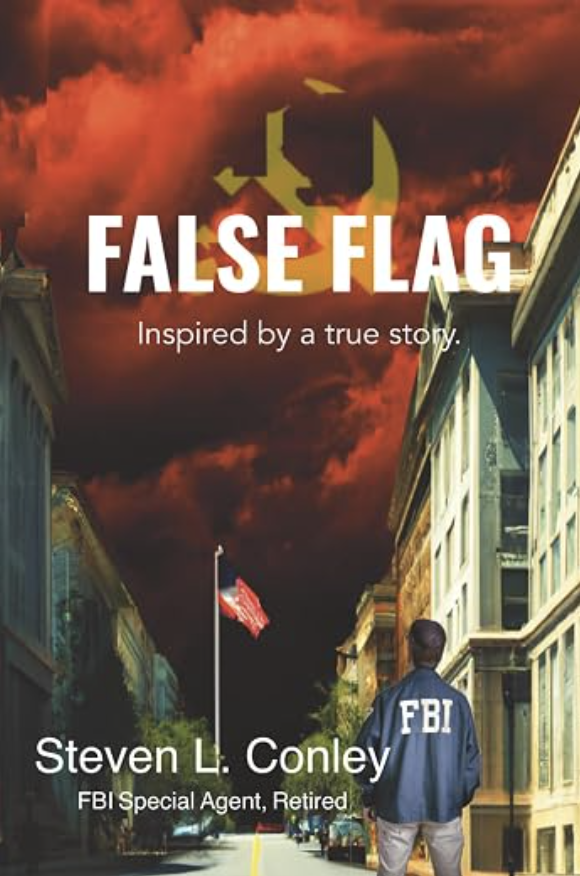
That sensibility runs through False Flag, Steven’s new espionage novel, a fictionalized account inspired by the hunt for a Chinese mole inside the FBI. The book occupies that uneasy borderland between thriller and confession. It has the machinery readers expect from excellent spy fiction, dead drops, surveillance, compromised agents, headquarters intrigue, but its engine is less gadgetry than institutional memory. Steven is not merely imagining the bureaucracy of secrecy. He lived inside it.
The story draws from a real double-agent operation that lasted roughly two decades and centered on a source with extraordinary access to Chinese officials. Warnings accumulated for years. Reports suggested compromise. Anomalies surfaced. Yet the concerns were repeatedly routed back to the very handling agent who had the power, and perhaps the motive, to make them disappear. Steven tells me the disaster was not only betrayal. It was trust fossilized into procedure.
False Flag becomes mesmerizing when it considers the gap between what an investigator knows and what the law permits him to prove. Steven speaks of that distinction not as a television cliché but as a professional wound. In national-security work, suspicion must pass through a labyrinth of rules, affidavits, source vetting, Foreign Intelligence Surveillance Act applications, Justice Department scrutiny, and judicial discretion. Even evidence can become vulnerable to “graymail,” the threat that classified sources or operations will be exposed in open court unless charges are abandoned or softened. In such a world, truth is not self-executing. It must survive process.
There is also, beneath the plot, a quieter book about the cost of learning to observe too well. Steven describes how counterintelligence trains the eye to notice what does not fit: the nervous man, the wrong clothing for the weather, the stranger who asks too many personal questions, the casual approach that may be a “bump,” a sudden, unexpected increase in activity that may indicate a developing threat. That alertness can keep a person alive. It can also make ordinary life feel staged, every friendliness faintly suspect.
I felt none of that when our paths first crossed at a writer’s conference. And the conversation that is the basis for this essay felt like two colleagues sharing the commonalities of a craft where deconstructing plot, motive and characters become the common ground on which friendships are built. Perhaps that’s what makes the best operative… the best storyteller. Even as you engage in the rituals of a relationship, you observe and analyze, without the other person realizing it.
Steven Conley told me that writing the novel was cathartic. It’s easy to understand why. The secret life is not only secret from adversaries. It is secret from spouses, children, friends, and sometimes from oneself. False Flag asks what happens when the enemy is already inside the room. Its deeper question may be what happens to the people trained to notice him before anyone else does.