

Hear the Conversation | Get the Book
For Jim Charles, who once upon a time co-led a $100 billion unit of a large asset manager and spent his time managing some of the largest and most complex institutional relationships the firm had, the low point of retirement arrived in 2021, in the hazy interregnum of the pandemic. Thirty-five years in financial services had deposited him at what was supposed to be the golden edge of the American dream: ample savings, abundant time, and the theoretical liberty to reinvent oneself. What he discovered instead was a void.
His wife, Sarah K. Charles, also steeped in the grammar of finance, was still working, which left Jim marooned in a silence he had never learned to navigate. In an attempt to bestow upon him a new, post-executive identity, she suggested he take over the cooking. To Jim, the proposal sounded less like a domestic reallocation of labor and more like an opportunity for a second career. He approached the kitchen with the same fervor he once directed at presenting to pensions and foundation boards. He studied cookbooks. He plotted grocery hauls with the zeal of a market analyst. A “30-minute easy weeknight meal” of fried sweet potato tacos turned, under his stewardship, into a day-long odyssey that cost over three hundred dollars and required a mid-prep excursion to Williams Sonoma for a Dutch oven, a pot that gleamed with the promise of purpose.
The resulting taco, both agree, was a catastrophe. Grease and defeat splattered across the countertops. The sweet potatoes collapsed in on themselves, as though succumbing to the weight of Jim’s expectations.
“It was a forced identity,” he says now, the phrase carrying the rueful wisdom of someone who has tried to purchase meaning as if it were a kitchen utensil. The lesson came sharply into focus: you cannot accessorize your way into a sense of purpose. Not even with a high-end piece of cookware.
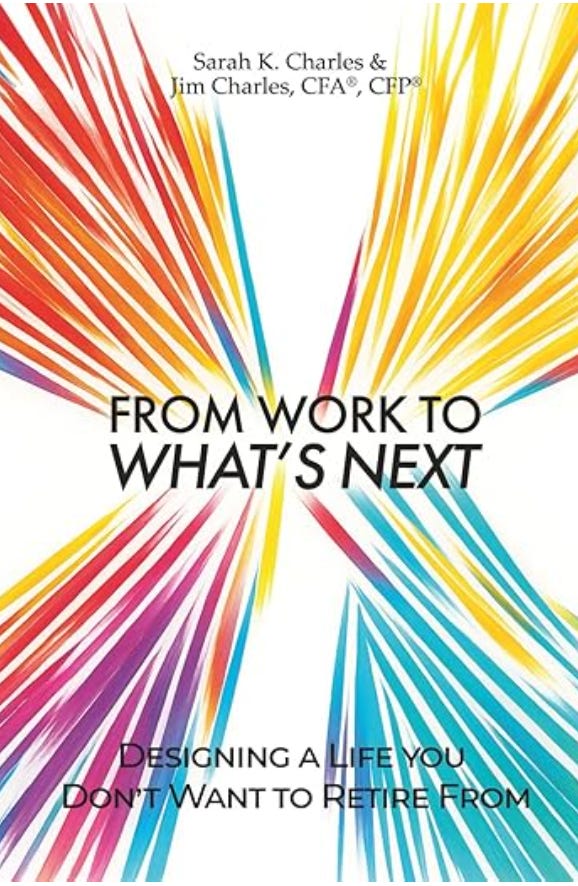
This domestic parable forms the opening note of From Work to What’s Next: Designing a Life You Don’t Want to Retire From, the new book authored by the Charleses. In a genre dominated by admonishments about inflation and promises of market-beating returns, the couple has written something closer to a psychological field guide, a manual for navigating the blank space that appears when the email alerts stop.
As founders of Sanctuary Financial Planning, Sarah and Jim operate at the unlikely intersection of professional expertise and personal disorientation. The financial world, they argue, has become expert at solving the math of retirement while remaining curiously uninterested in the more pressing question: What is a life when work no longer defines it? “Retirement is a use-of-time problem, not a money problem,” Jim says, sounding less like a planner than a philosopher who has discovered an unbudgeted truth.
For decades, retirement has been framed as a finish line, a metaphor so pervasive that it has calcified into cliché. Sarah, a “reformed runner,” points out the central flaw: once you cross a finish line, you collapse. What follows is not triumph but depletion. The Charleses argue that when leaving a career is treated as a cessation of effort, we all become at high risk for mental atrophy. “If I don’t start using the six inches between my ears, this is gonna turn to mush,” Jim recalls.
Their book introduces what they call the Retirement Paradox. Drawing on a statistic cited by BlackRock chairman Larry Fink, they note that two decades after retirement, nearly eighty percent of us retain almost eighty percent of our savings. The very mindset that enabled financial security becomes a cage. We will happily spend predictable income such as Social Security but recoil at touching the nest egg we spent forty years building. We remain affluent in theory but experience-poor in practice.
For the Charleses, this outlook was not merely academic. While Jim wrestled with the disorientation of unscheduled days, Sarah confronted a corporate merger that threatened to upend the future she had rehearsed in her mind. At forty-seven, she began consulting her “future self”, a calm, discerning avatar known as Sixty-Five-Year-Old Sarah, who advised her to stop clinging to a dissolving structure and instead carve out something sturdier.
The result was Sanctuary; a firm premised on the notion that retirement is not a cliff but a redesign. Withdrawals become a “retirement paycheck”, an income stream from one’s past self to one’s present self. More importantly, the couple insists that clients must undertake the labor of introspection, an act far more destabilizing than any market downturn. “You can’t just sit in bed and doom-scroll the headlines every day,” Sarah says, a warning that doubles as memoir.
Their framework includes tools, like “Financial ikigai,” “Dynamic Income Planning,” and “Statements of Financial Purpose.” But these instruments are scaffolding, not salvation. The real work is narrative. They invoke Arthur Brooks’s metaphor of the jade block: retirement is not a blank canvas, but a solid mass awaiting its inevitable shape. We must chip away until the form reveals itself.
For Jim, the form was not that of a chef. It was, rather, a return to the familiar terrain of financial planning,but with a fundamental reimagining. Together, Sarah and Jim built Sanctuary on a principle that flew in the face of industry convention: they don’t charge based on assets under management. In a profession that profits when clients hoard their savings, they built a firm with no financial incentive to perpetuate the very Retirement Paradox their book exposes. What emerged was not a retirement in the traditional sense, but a life redesigned from the inside out, and a business model that practices what they preach.
It turns out that the elusive secret to post-career fulfillment is not buried in a portfolio allocation or a perfectly caramelized vegetable. From Work to What’s Next: Designing a Life You Don’t Want to Retire From reminds us, it can be found in the steady, deliberate shaping of days, days that require no escape hatch, no Dutch oven, only the quiet assertion that meaning, at last, belongs to the chooser.