
Hear the Conversation | Get the Book
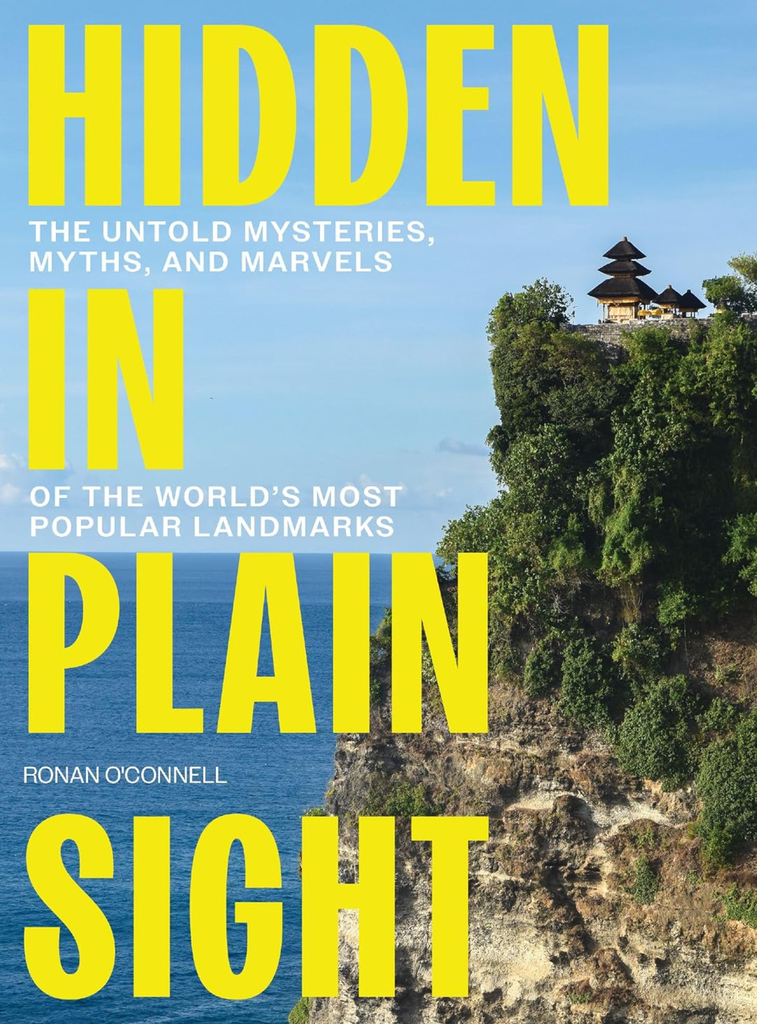
We live in an age of pre-digested wonder. When we travel, a place is rarely encountered before it is explained, summarized, and ranked. Yet, as Ronan O’Connell suggests in his quietly subversive new book, Hidden in Plain Sight, the deeper truth of these monuments is not what we see, but what we have failed to notice.
Ronan did not set out to write a book. Like many of the most interesting careers, his began in the methodical churn of daily journalism, covering crime and politics in Perth, Australia. Travel entered his life not as a calling but as a detour. In time, it became a vocation. It is a trajectory that mirrors the spirit of his work. He is less interested in the grand narrative than in the accidental discovery, the story that emerges when one is not looking directly at it.
The premise of Hidden in Plain Sight is deceptively simple. Take the world’s most recognizable landmarks and excavate the stories that have been smoothed over by repetition. The result is not a rejection of the familiar, but a reframing. The landmarks remain what they are, yet they are also revealed to be something else entirely, repositories of forgotten tensions, unlikely histories, and cultural echoes that have slipped through the cracks of mass attention.
What Ronan identifies, with a kind of gentle insistence, is a modern erosion of curiosity. Information is abundant, but depth is scarce. The guidebook has been replaced by the algorithm, and with it, a flattening of experience. A traveler searches for history and receives instead a chorus of identical summaries, each one echoing the last, each one sufficient but incomplete. The effect is not ignorance so much as a quiet narrowing of perspective.
Against this, Ronan proposes a different way of seeing. His process is almost anthropological. He digs, cross-checks, consults locals, discards what cannot be verified, and lingers on what resists easy explanation. In some cases, the stories he uncovers are factual, grounded in the sediment of recorded history. In others, they belong to the realm of myth, shaped less by evidence than by belief. Both, he suggests, are essential. To understand a place is not only to know what happened there, but to understand what people think happened, and why.
There is, too, an undercurrent of humility in his work. Travel, for Ronan, is not conquest but exposure. It reveals the contingencies of one’s own life, the freedoms taken for granted, the histories overlooked. In his case, it led to a renewed fascination with Indigenous Australian culture, a realization that the oldest continuous civilization on earth had been, for much of his early life, effectively invisible to him.
Perhaps the most striking aspect of Ronan O’Connell’s perspective is his resistance to the prevailing narrative of global decline. Having seen the world up close, he argues that reality is less dire, and more nuanced, than the mediated version we consume. The problem is not that darkness exists, but that it is disproportionately illuminated. Step outside, he suggests, and the balance shifts.
In the end, Hidden in Plain Sight is less about landmarks than about attention. It asks the reader to reconsider not only what is seen, but how it is seen. The familiar, it turns out, is not exhausted. It is merely underexamined.