

Hear the Conversation | Get the Book
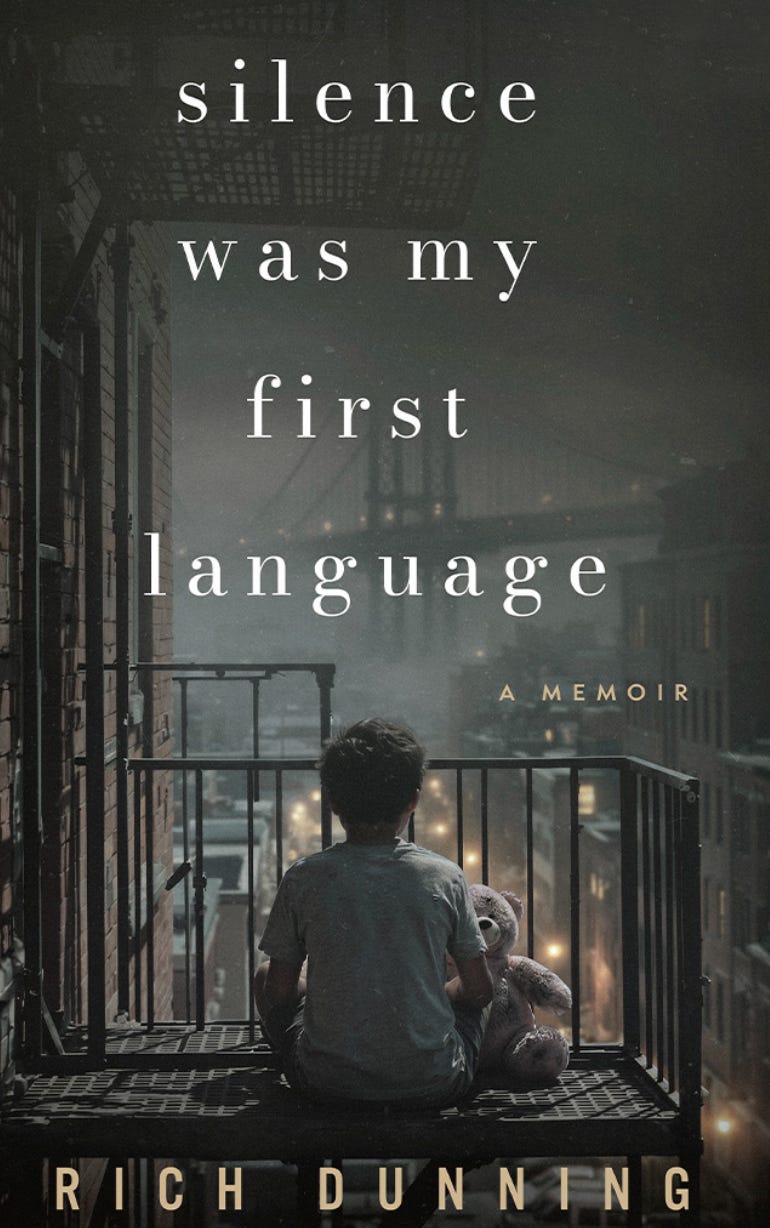
In the Bronx of Rich Dunning’s childhood, silence was less an absence of sound than a form of intelligence. Before he learned English, at five, he had already become fluent in the domestic acoustics of danger. He knew the significance of footsteps in a hallway. The weight of a door opening. The atmosphere that gathered in a room before something bad happened. His first-generation family spoke Spanish at home, but the language that mattered most was unspoken.
His biological father left when Rich was three. A stepfather arrived two years later, ushering in a childhood marked by poverty, fear, and physical abuse. Rich was given the nickname “Dog,” a small cruelty with a surprisingly long half-life. He learned that attention was dangerous. The safest boy was the boy no one noticed.
“The only way to survive the day was to be invisible, to be silent,” he told me.
That instinct would eventually lend its name to his memoir; Silence Was My First Language. It would also follow him long after the circumstances that created it had disappeared.
Adults who survive troubled childhoods sometimes become highly skilled at constructing convincing lives. Rich built an impressive one. He became a senior executive in the medical-device industry, acquired the beautiful home and successful career. He married, raised children, and accumulated the outward evidence of stability. Achievement became another kind of camouflage.
Yet the habits that had once protected him remained intact. Hypervigilance became emotional distance. Control became detachment. The boy who learned not to be seen became a man who had difficulty allowing himself to be known.
Alcohol offered another inheritance from childhood. Rich says he was introduced to hard liquor at family gatherings at seven and considered himself an alcoholic by thirteen. By 2009, drinking had begun to consume the life he had so carefully assembled. The next seven years brought blackouts, denial, and an increasingly unstable home life. He was not, by his account, an angry drunk. But unpredictability has its own violence. Without intending to, he began recreating for his children something of the atmosphere he had once tried to escape.
The reckoning came on a family vacation. By the second day, his drinking had ruined the trip, and he was confined to his room. Early the next morning, alone on a fifth-floor balcony, Rich decided he could no longer endure the damage he was causing. He began climbing over the ledge.
Then his youngest son woke and called for him. It was an ordinary sound carrying extraordinary consequence. Rich stepped back inside, fell to his knees, and asked for help. He says he has not had a drink since.
Now fifty-five, Rich has spent years learning the opposite of what childhood taught him. After thirty-four years with his wife, he describes their marriage as stronger than ever. His memoir took fifteen years to complete, not as an indictment of everyone who failed him but as an examination of what survival can become when it outlives the danger.
He has also established the First Language Foundation, pledging a dollar from every copy sold to programs serving young people facing homelessness, trauma, and food insecurity.
For most of his life, silence kept Rich Dunning alive. Speaking, finally, has given that survival a purpose.