
Hear the Conversation | Get the Book
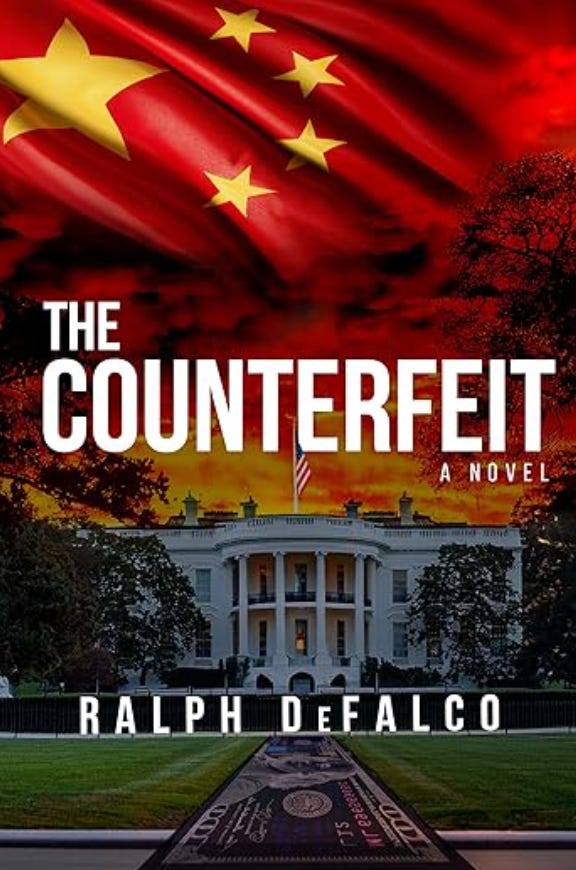
There is a particular kind of unease that lingers after a conversation with Dr. Ralph DeFalco, the sort that does not dissipate when the interview ends, but instead settles in, quietly rearranging one’s sense of what is plausible. His new novel, The Counterfeit, is not content to entertain. It insists on recognition.
Dr. DeFalco, who spent decades inside the machinery of American intelligence, writes with the authority of someone who has seen how systems bend before they break. His premise is stark. The United States, following a catastrophic conflict in the Pacific, has been defeated, economically hollowed out, and politically compromised. In the vacuum, a strange hybrid emerges. A nation governed in part by outside forces, administered by a United Nations commission, and divided internally between those who wield power and those who endure it.
It sounds, at first, like the scaffolding of speculative fiction. Yet Dr. DeFalco resists the label. He describes the novel less as invention than as extrapolation. History provides the patterns. The present supplies the trajectory. The novel follows both to their logical conclusion.
What distinguishes The Counterfeit from the more extravagant corners of the thriller genre is its refusal of spectacle. There are no gravity-defying stunts, no gadgets masquerading as plot. Instead, the tension accrues in quieter, more disquieting ways. Dr. DeFalco has described his approach as “cliffhangers without cliffs,” a phrase that captures the novel’s peculiar rhythm. The danger is constant, but rarely theatrical. It feels, rather, like something that could happen on an ordinary street, under ordinary light.
At the center of this unraveling is Philip Nolan, a protagonist who bears little resemblance to the polished heroes of conventional espionage fiction. Nolan is not invincible. He is not even particularly certain of himself. Tasked with assuming his brother’s identity to infiltrate a powerful security apparatus, he becomes, in effect, a man living a forgery. The novel’s title gestures toward this central conceit, but also toward something broader. Identity, in DeFalco’s world, is unstable. Individuals counterfeit themselves. Institutions counterfeit legitimacy. Even the nation begins to resemble a facsimile of what it once claimed to be.
Nolan’s struggle is not merely operational. It is existential. To imitate another person convincingly requires a kind of psychological surrender, a willingness to inhabit not just a role but a moral landscape that may be alien, even repellent. In Nolan’s case, that landscape is shaped by a brother he scarcely knew and ultimately comes to regard as monstrous. The result is a protagonist who is perpetually off balance, navigating not only external threats but an internal erosion of self.
Dr. DeFalco’s thematic concerns. loyalty, freedom, courage. are less presented than braided together. Courage, in this context, is not the absence of fear but the ability to act while fractured by it. Loyalty is provisional, constantly tested against competing allegiances. Freedom, meanwhile, becomes something more abstract and elusive, a condition remembered as much as experienced.
There is, too, an unmistakable undercurrent of warning. Dr. DeFalco speaks openly of the novel as a cautionary tale, though he seems less interested in moralizing than in provoking a kind of uneasy reflection. Why, he asks, do societies fail to learn from history. His answer is disarmingly simple. We forget. Or perhaps more dangerously, we assume that what has happened elsewhere cannot happen here.
In The Counterfeit, that assumption is stripped away. What remains is a portrait of a country not undone by a single dramatic collapse but gradually reshaped by forces both external and internal. It is this incremental quality that gives the novel its power. The reader is not jolted into disbelief, but guided, step by step, into recognition.
And that, finally, is what lingers. Not the mechanics of the plot, though they are skillfully rendered, but the unsettling sense that the distance between fiction and reality may be smaller than we would prefer to imagine.