

Hear the Conversation | Get the Book
From the windows of his restored, two-hundred-year-old house on an island off the coast of Maine, R. John Dingle can watch the weather’s unpredictable impact on the world surrounding him. It is the sort of place that seems less inhabited than temporarily occupied. It provides an appropriately unsettled headquarters for a writer who pens stories of isolation, buried guilt, and the elaborate secrets of small towns.
John’s thrillers follow Gus Wheeler, an F.B.I. agent whose investigative gift is rooted not merely in observation but in tempo. Gus recognizes patterns the way a jazz musician hears a progression developing beneath a melody. His mind moves associatively, collecting fragments that appear unrelated until they resolve into a larger design. The character was inspired by John’s middle son, Sam, a professional jazz musician with severe dyslexia. For Gus, what conventional thinking might classify as a limitation becomes an unconventional form of intelligence. He does not solve crimes by proceeding neatly from letter A to B. He improvises.
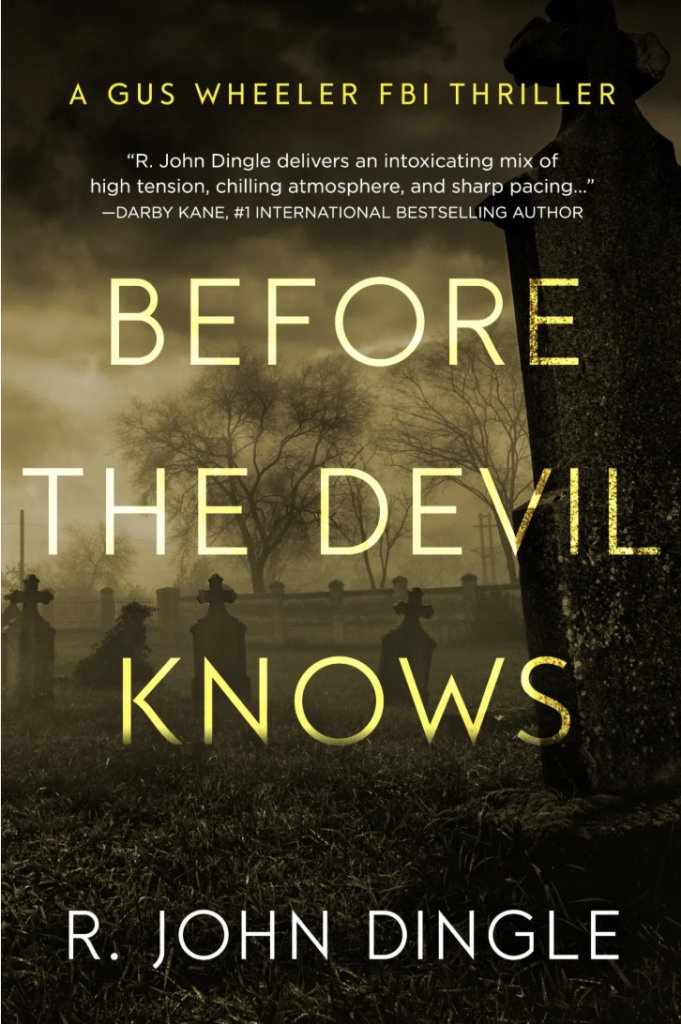
In John’s latest novel, Before the Devil Knows, that improvisational mind confronts an especially rigid system of belief. The story begins with the discovery of a missing teenager’s disfigured remains in an unmarked grave. A heavy lead cross has been placed across the body’s chest. When a second grave is found, Gus and his partner are drawn toward a secretive church whose members adhere with disturbing literalness to the Old Testament.
John sets the novel in the remote expanses of northern Maine, including Aroostook County, where distance is not a scenic detail but a governing fact. Communities can exist beyond the electrical grid, the cellular network, and the casual surveillance of social media. In such places, privacy may shade into secrecy. Faith, unchallenged by outside scrutiny, can be reshaped into something punitive. The novel’s villain uses ancient scripture as both justification and weapon, attempting to impose an archaic moral order upon the modern world.
The premise had occupied John for decades. He was fascinated by the possibility that religious practices created thousands of years ago might reappear in contemporary life, not as metaphor but as instruction. Yet the novel’s ending was not ordained. John is not a “pantser,” a word those of us in the trade use to describe writing stories by the seat of our pants. He is a meticulous outliner who often sees his final scenes before he writes his first. In this case, a suggestion from Sam prompted him to rewrite both the conclusion and the epilogue at the last moment. The chord progressions made room for improvisation.
His route to publication required an even greater tolerance for revision. Before his first thriller appeared, John sent 283 queries and twenty-two full manuscripts to agents and publishers. Securing representation took six months. Finding a publisher took a year and a half. He now has a multi-book agreement promising at least six Gus Wheeler novels, but he speaks of his unpublished work without bitterness. Those manuscripts were preseason, he tells me, the necessary repetitions through which a musician learns how to make his instrument sing and a writer discovers his voice.
John Dingle’s advice to aspiring authors is correspondingly plain: sit down and write for the pure enjoyment of the act. He does not claim that thrillers will redeem society. His books contain murder, fanaticism, and the darker uses of belief, but his purpose is entertainment. He wants readers absorbed, unsettled, and finally surprised.
Before the Devil Knows delivers it all.