
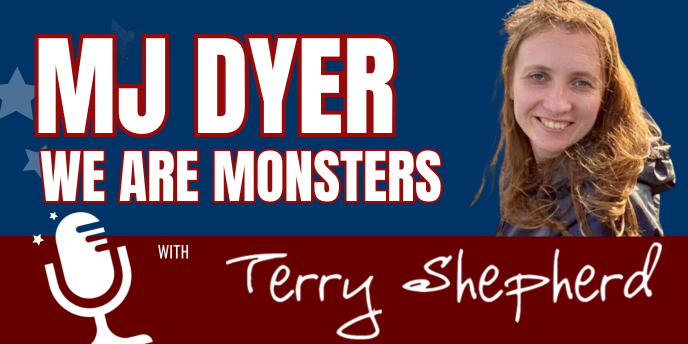
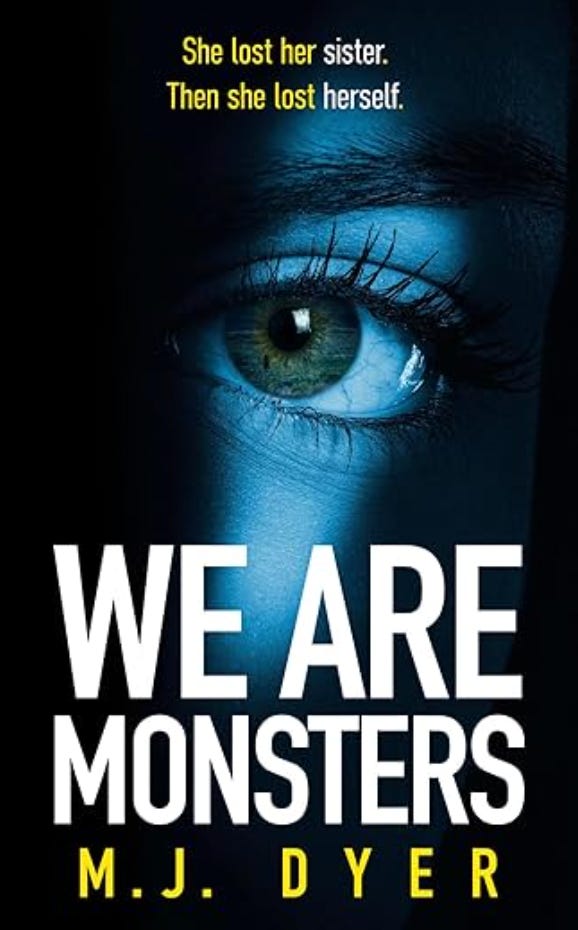
Hear the Conversation | Read the Book
There is something almost Victorian about the origin story of M.J. Dyer’s We Are Monsters. It begins not with a candlelit manor or a governess on the moors, but in a hospital room, where the author, recovering from brain inflammation, began seeing three identical sisters. They appeared first in nightmares and hallucinations. Later, in a charity shop, M.J. found an old photograph from the early twentieth century: three identical sisters, looking uncannily like the women her injured brain had invented. A less haunted writer might have taken this as coincidence. M.J. took it as instruction.
The result is a psychological thriller set on Bodmin Moor, that ancient, uneasy landscape of southwest England where fog and stone seem to conspire against certainty. Our heroine, Elara, lives in the shadow of identical twin sisters, Halley and Astrid. When Halley is found dead and the death is ruled an accident, Elara refuses to accept the official version. But her pursuit of the truth is not pure. She wants justice, perhaps, but she also wants to be seen. The investigation becomes less a searchlight than a mirror, reflecting back rivalry, grief, envy, and the terrible hunger of a person who has spent her life standing just outside the frame.
M.J. is especially alive to the gothic strangeness of twins. These natural doubles make the ordinary feel faintly supernatural. To be a third sibling beside such a pair is to live as an afterthought in a household already complete. Elara’s self-worth depends on the twins’ attention, and her desperation gives the book its unnerving emotional current. M.J.’s title, she tells me, was present from the first paragraph. Monstrosity is not a costume worn by villains. It is a capacity, hidden in plain sight, waiting for pressure, neglect, or jealousy to summon it.
That pressure has a personal analogue. M.J. has spoken candidly about how her illness altered her relationship to perception. During recovery, she remembered birds in her hospital room, felt their wings stir the air, heard and saw them, only to understand later that they had never been there. The terror of being unable to trust oneself, finds its way into Elara’s fragile mental state. The novel’s suspense arises not only from what happened to Halley, but from whether the person asking the questions can rely on the answers her own mind supplies.
Before We Are Monsters, M.J. Dyer wrote fantasy and science fiction under another name. Illness changed her language. After losing the ability to speak and write, she began returning through poetry, and that lyric impulse now shapes her fiction. She writes not simply to entertain, but to process experience, to make feeling legible. In We Are Monsters, the thriller becomes a conduit for more intimate disturbances: the ache of comparison, the violence of invisibility, the ways families manufacture ghosts before anyone has died.