

Here the Conversation | Get the Book
For L. Mark Weeks, who spent much of his career practicing law in Tokyo, professional success came with the quiet understanding that one’s calendar belonged largely to other people. Time was a commodity, divided into billable hours. Achievement was a partnership and the material rewards that came with it.
At fifty-six those definitions were turned upside down and Mark Week’s reinvented himself, thanks to a fish.
He left his position as the managing partner of a major law firm and set two goals that were dangerously specific. He wanted to win one of the legendary tarpon tournaments in the Florida Keys before turning sixty. He also wanted to write a novel about the people who pursue the fish with a devotion that can resemble faith, addiction, and perhaps, temporary insanity.
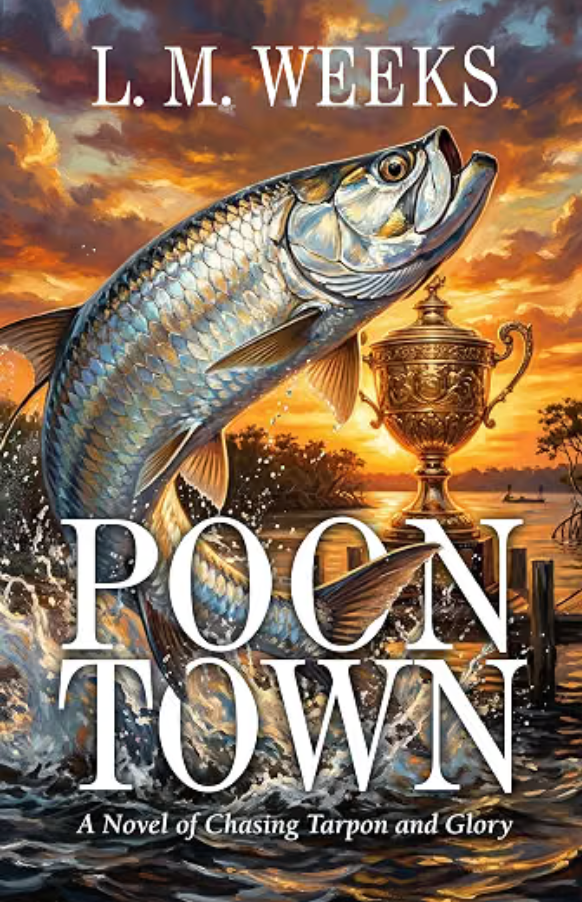
He achieved both. His novel, Poontown: A Novel of Chasing Tarpon and Glory, takes place during an elite five-day tournament, where large sums of money, personal pride, and fragile alliances drift across water often shallow enough to stand in. The title comes from the private lexicon of tarpon anglers, who shorten the fish’s name to “poon” The tournament’s home in Islamorada is often referred to, with a mixture of reverence and locker-room affection, as Poontown.
Mark’s own conversion began after law school, when he wandered into an Orvis store in New York and was soon catching striped bass from a beach. This was, he tells me, the gateway drug. Tarpon came later, along with the permanent division of his biography into pre-tarpon and post-tarpon life.
The decisive encounter involved a ninety-pound fish in the clear waters of the ocean flats. Six feet of muscle and silver scales rose from the sea and seemed, for a moment, to violate the ordinary laws governing animals, gravity, and adult priorities. After that, Mark began spending weeks in the Keys. He has compared the experience to visiting Neverland as a Lost Boy. Careers, titles, and civilized anxieties recede. What remains is the fish, the weather, and the tide.
Mark chose to write fiction rather than memoir. It was a distinction that is especially useful in a community protective of secret fishing spots and boat-bound confidences. A skiff can become an aquatic confessional. People say things there that they would not tell a therapist. Perhaps because the tarpon are indifferent and semi-solitude feels like a safe place for the revelation of secrets.
Tournament fishing intensifies every weakness in the arrangement. Mark remembers one extraordinary day when he fed eighteen tarpon and landed six. Instead of celebrating, he lay awake thinking about the twelve that got away. Competition, he says, can extract joy from an otherwise perfect day.
The fish, however, is not the true antagonist. The greater contest occurs between expectation and composure, and within the delicate partnership of angler and guide. Mark and Captain Andy Thompson endured that pressure together, eventually winning the Don Hawley Invitational and the HLM Tarpon Cup.
L. Mark Weeks likes to cite a proverb, possibly Chinese and possibly invented. It holds that a day spent fishing is not deducted from one’s allotted time on Earth. Poontown is his attempt to preserve those uncounted days. It is a place where a lawyer becomes a Lost Boy and each cast carries the possibility that life might still surprise us.