
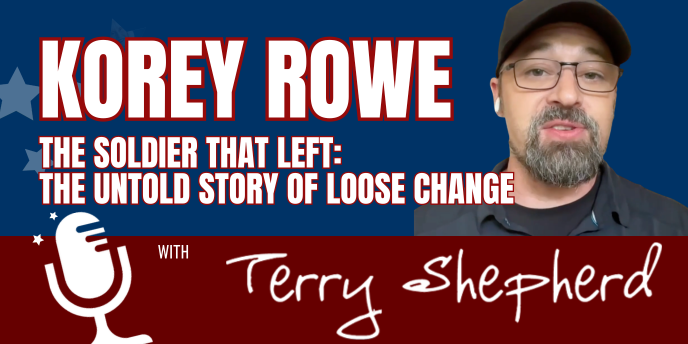
Hear the Conversation | Get the Book
In the late summer of 2001, Korey Rowe was eighteen years old and sitting on a lawn in Oneonta, New York, contemplating no future. He had dropped out of high school and was living in a financially challenged region where opportunity was sparce. When an Army recruiter happened by, Korey listened. The proposition sounded manageable: four years, some training, and after the service, some cash and perhaps a little golf. He enlisted.
His first day of basic training turned out to be September 11th. Alarms sounded across the base. Tanks appeared. The Twin Towers collapsed on television screens the recruits were not allowed to see. The quiet interval Korey had imagined between adolescence and adulthood ended almost immediately.
Within months, he was in Afghanistan. Later came Iraq, where the abstractions of patriotism confronted the practical realities of war. He encountered confusion, civilian deaths, dead friends, sleeplessness, and fear. Korey was also told to take mefloquine, an antimalarial medication associated with potentially serious neuropsychiatric effects. Whatever trust he had placed in military authority gradually gave way to suspicion. He came to believe that the government had misled the public about the wars it was asking young people to fight.
When the Army ordered him to return for a third deployment, despite completing his contract, Korey refused. He went absent without leave during wartime, entering the peculiar existence of a fugitive whose crime was inseparable from his conscience.
While in hiding, he reconnected with a childhood friend, Dylan Avery, who was working on a fictional film about September 11th. Korey contributed his military experience, and the project slowly transformed into “Loose Change,” a documentary challenging the official account of the attacks. Released online when internet video still felt like an experiment, the film spread with astonishing speed. It became one of the first viral political documentaries, passed from computer to computer like forbidden evidence.
Korey’s life acquired the improbable contours of satire. A wanted soldier found himself speaking with celebrities, negotiating with Hollywood figures, and discussing possible deals involving Charlie Sheen and Mark Cuban. He had escaped one institution only to become entangled in another, the newly forming economy of internet attention, where notoriety could resemble both liberation and captivity.
The success of the film did little to settle him. Korey was living with post-traumatic stress disorder and bipolar disorder, though neither had yet been brought fully under control. He drank, used drugs, and descended into periods of instability. Publicly, he had become a symbol of dissent. Privately, he was struggling to remain intact.
Recovery took years. Korey credits therapy, medication, Stoic philosophy, and Adlerian psychology with helping him reconstruct a life from the fragments. Six years after leaving the Army, he presented his case to military officials and received an honorable discharge.
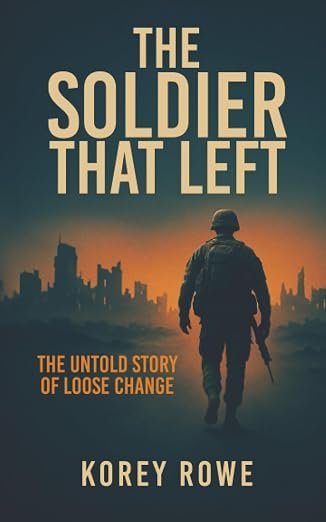
His memoir, “The Soldier That Left: The Untold Story of Loose Change,” is less an argument about September 11th than an account of what it costs to build an identity around resistance. To write it, Korey returned to journals he had kept in Iraq and to memories he had spent years trying to suppress.
Korey Rowe now lives in the town he once wanted to escape. He is married, has two children, and owns a cannabis dispensary. The fugitive filmmaker has become, in middle age, a local businessman and positive community figure. His wars have not vanished. They have merely become quieter, the kind fought through memory, routine, discovery and the difficult maintenance of inner peace.
It’s an inner conflict many of us share and an inspiring story of how one man reached beyond survival to touch the summit of accomplishment.