Hear the Conversation | Get the Book
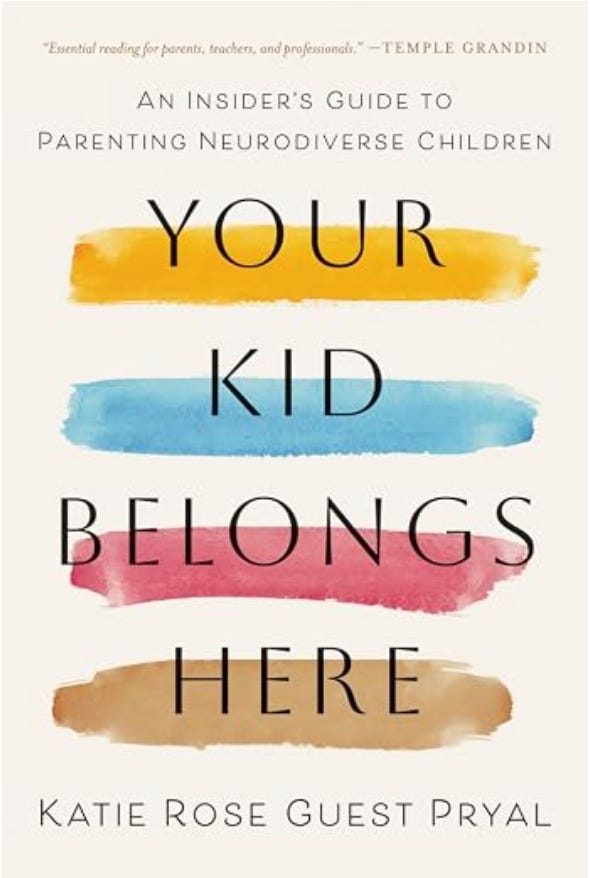
Some books arrive dressed as manuals, carrying the sturdy promise of advice. Others come as dispatches from the interior, written by someone who has survived the territory and returned with a map. Dr. Katie Rose Pryal’s Your Kid Belongs Here is both. It is a parenting book, certainly, but also a work of moral correction, a quiet indictment of the systems that have asked generations of children to earn their humanity by pretending to be someone else.
Dr. Pryal, a bipolar autistic writer, educator, and advocate, writes from the far side of a childhood shaped by misunderstanding. She remembers the precise moment when difference became danger. Elementary school, with its magnet-school tolerance for odd angles of thought, had given her room to breathe. Middle school took that air away. Suddenly there were rules, invisible and absolute. She did not know the right things to say, or how to say them. She dressed wrong, talked wrong, liked the wrong things. The punishment for this was not correction, but exile.
Like many gifted children who are made to feel unacceptable, young Katie learned to compensate. She excelled. She became perfect or tried to. Behind that achievement was a bargain familiar to many neurodivergent adults: If I outperform everyone, maybe I will be loved. It is a devastating lesson for a child to absorb, and a difficult one for an adult to unlearn.
Your Kid Belongs Here is Dr. Pryal’s attempt to interrupt that inheritance. She is not interested in turning neurodivergent children into more convenient versions of themselves. She is interested in helping parents recognize what is real. The anxiety, the meltdowns, the exhaustion of masking, the need for quiet, the longing for friendship, the brilliance that can emerge when a child is not spending every ounce of energy trying to pass is real.
Her counsel is practical, but its roots are radical. Validate the child. Ask what is hard. Offer choices. Make room for “brain breaks.” Stop treating difference as defiance.
One of Dr. Pryal’s most useful distinctions is between masking and what she calls social acting. Masking is shame disguised as survival. Social acting is deliberate, temporary, and chosen. A child may practice gratitude for a disappointing gift or dress up for a formal dinner, but the performance is not a referendum on their worth. It is a tool, not a cage.
The deeper argument of the book is larger than neurodiversity. Dr. Pryal asks us to reconsider the narrow corridor through which children are expected to pass on their way to adulthood. Schools, camps, teams, clubs, and even families often reward compliance while calling it maturity. But children develop unevenly. One child may be intellectually dazzling and socially young. Another may appear composed because life has required too much too soon. The question is not how quickly they can conform, but whether the world around them is spacious enough to let them become whole.
Near the end of our visit, Dr. Pryal offered a simple test. Did your child harm themselves? Did they harm someone else? Did they damage property? If not, then your kid belongs here. It is a sentence with the force of a door opening. And if “here” is not ready for your child, Dr. Pryal insists, find another here. It’s much better to have a child love themself in an unconventional place than to disappear inside a respectable one.
In the end, Your Kid Belongs Here is not merely a title. It is a promise, an instruction, and a rebuke. It says that belonging is not a prize for normalcy. It is where childhood should begin.