
Hear the Conversation | Get the Book
John Winn Miller lived several literary lives before arriving at Miriam in the Shadows, and one suspects that each of them left fingerprints on the page. He has been an investigative reporter, a foreign correspondent, an editor, a publisher, a filmmaker, and a screenwriter. These are not merely résumé items. They are disciplines of attention. Journalism taught him to notice weather, smell, clothing, fear, and the small physical truths that make a scene breathe. Screenwriting taught him restraint, that old cinematic law that emotion must be seen or heard before it can be believed. Historical fiction, in his hands, becomes the place where fact and feeling are allowed to shake hands in the dark.
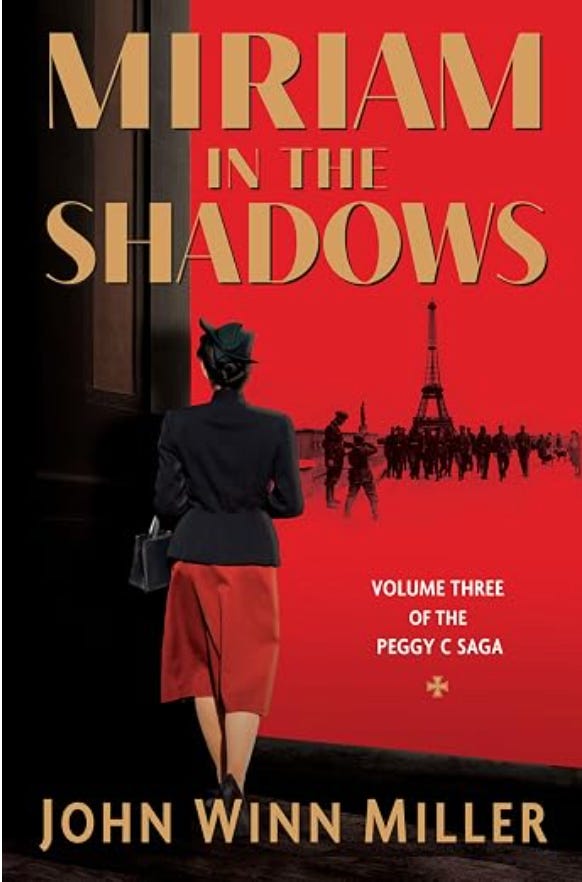
Miriam in the Shadows, the third novel in John’s Peggy C saga, is set in the spring of 1944, as the Allies prepare for D-Day and the Nazis pursue the terrible possibility of turning V2 rockets into radioactive weapons. It is the sort of premise that could become an exercise in machinery: rockets, codes, uniforms, mines, maps. John gives us all of that, but he puts a woman whose interior life is as dangerous as the war around her at center stage.
Miriam is a young Jewish mother from Amsterdam, trained by Britain’s Special Operations Executive, captured and tortured by the Nazis, then pushed back into the field for one more mission. She is not drawn as an invulnerable heroine. She is competent, lethal when survival requires it, and haunted. She carries survivor’s guilt and maternal terror along with the tools of espionage. The result is not a female version of the square-jawed commando, but something more unsettled and therefore more convincing. She is a survivor, a weapon, a mother, and a moral being trying to remain one.
The book’s central question is brutal because it is intimate. Two stark choices: complete the mission and perhaps help save D-Day or save the man she loves. Thrillers often depend on large stakes, but John understands that history becomes most unbearable when it presses against the body. Nations are at war, but Miriam’s choice is heartbreakingly personal. What would any of us trade for freedom? And if the cause is righteous, does that make every act in its service righteous, too?
John’s espionage world is appropriately murky. Ian Fleming appears before James Bond made him mythic, and Claude Dansey emerges as a figure of institutional menace, a reminder that allies can be as dangerous as enemies when secrecy becomes its own government. John is fascinated by what he calls the wilderness of mirrors, It is a realm where loyalty is provisional, identity is performance, and truth arrives disguised.
What distinguishes Miriam in the Shadows from the crowded shelf of World War II fiction is not simply its research, though John clearly relishes the archival grain of history. It is the novel’s moral unease. He is not asking whether Nazis must be defeated. He is asking what defeating them costs the soul. Miriam’s courage is not fearlessness. It is trembling forward anyway, guided by a compass that war keeps trying to smash.
In that sense, John Winn Miller has found in historical fiction what journalism could not always permit: the emotional weather behind the documented fact. Miriam steps out of the shadows carrying history’s burden, but also its warning. Freedom is fragile. Evil is organized. And courage, when it matters most, is rarely clean.