
Hear the Conversation | Get the Book

The American success story has long been drawn as an arrow pointing upward. The better job, the bigger salary, the more impressive title, the house in the right ZIP code, and, at the end of it all, a retirement sufficiently picturesque to justify the decades spent getting there. Denise Perez followed this trajectory for a time. She became a highly successful commercial-insurance producer for a company traded on the New York Stock Exchange and earned well into six figures. Then she walked away.
Today, Denise lives in Alachua County, Florida, where she is perfectly happy bussing tables. To describe this as a fall from grace would be to misunderstand both grace and Denise. She regards the move not as a retreat but as a promotion to a life in which the currency is no longer prestige but peace.
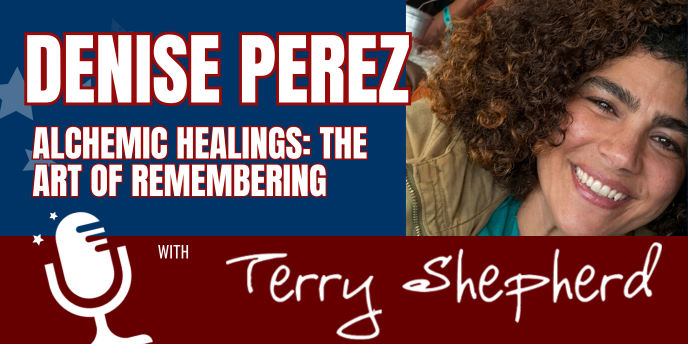
That transformation forms the heart of Alchemic Healings: The Art of Remembering, Denise’s memoir-inflected exploration of mysticism, grief, and self-reclamation. Its central proposition is deceptively simple: human beings are not defective machines in need of repair. We are, she tells me, spiritual beings who have forgotten what we already are.
Denise did not arrive at this conviction easily. Raised in a deeply conservative religious environment, she eventually rejected faith altogether and spent some fifteen years as an atheist. The crisis that began to undo that certainty came when her mother, the person Denise regarded as her most unconditional source of love, developed Alzheimer’s disease. Grief, frustration, and the accumulating sense that she was repeating the same mistakes finally brought Denise to her knees. In tears, she demanded that the universe show her another way.
The answer was unconventional. At a nonprofit fundraiser, Denise met a neuro-linguistic-programming practitioner with a Scottish accent who introduced her to energetic healing practices. Soon came a past-life regression, during which Denise envisioned herself as a seventeenth-century Frenchman, and later, ayahuasca. Denise describes plant medicine not as a magic cure but as a kind of psychological permission slip, allowing the subconscious to loosen its grip on its usual defenses.
Her defining experience occurred in July 2024, during an ayahuasca ceremony in the Peruvian Andes. Denise says she communicated there with her mother, who “transitioned” in 2019. The encounter was especially powerful because the message she received seemed to overturn the religious assumptions of her childhood. Her mother’s voice encouraged rather than condemned her spiritual exploration and insisted that she write a book.
Denise resisted. Who was she to dispense wisdom? She had no doctorate, no vast fortune, no credential certifying enlightenment. The answer she believes she received was both comforting and subversive: she was the world’s foremost authority on her own joy. Alchemic Healings grew from that idea.
Denise now works with clients in Florida using practices that include Reiki, Access Bars, and Akashic Records readings. Yet she resists calling herself a healer. The word gives her too much credit. She prefers facilitator, someone who holds a door open while another person discovers that the room has been there all along.
Even the more extraordinary moments in Denise’s life are filtered through this philosophy. She recalls a dawn encounter on a South Florida beach when a stranger approached her and announced that she was surrounded by angels. For Denise, experiences like these are less proofs than invitations. The point is not that everyone must believe what she believes, but that certainty itself may be a smaller container than we imagine.
Lately, Denise has been influenced by bestselling author Michael A. Singer and his teachings about surrender, particularly the danger of placing happiness inside a carefully prescribed box. Denise is now writing a second book while supporting her daughter, a chemical-engineering student, and continuing to construct a life that would once have seemed to her like failure.
She likes to quote the mathematician and philosopher Robert Edward Grant: “The universe is you inverse.”
It is an appropriately alchemical phrase. Denise now sees ordinary existence as a laboratory in which fear, grief, ambition, and regret are not wastes to be discarded but raw materials to be transformed. The old alchemists spent centuries searching for the philosopher’s stone, the mythical substance that could turn base metal into gold.
Denise Perez suspects they may simply have been looking in the wrong place.