

Hear the Conversation | Get the Book
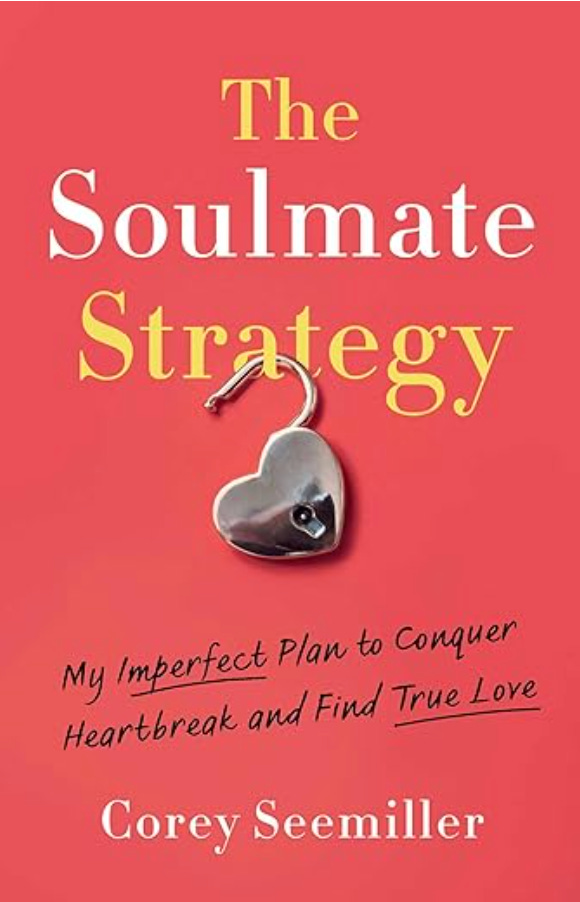
Among the rituals that constitute contemporary heartbreak, none is as revered, or as quietly doomed, as the Plan. Plans restore order to an interior life gone feral. They take the form of journal prompts, color-coded task lists, and flowcharts. For Corey Seemiller, a self-professed Virgo with a scholar’s discipline and a perfectionist’s appetite for structure, the Plan was less a coping mechanism than a compulsion. Add to this mindset having to recover from a breakup that was broadcast in searing detail across social media. The humiliation was public, the wound, private. And so, in a gesture both deeply modern and deeply human, she responded with a system.
Her new memoir, The Soulmate Strategy: My Imperfect Plan to Conquer Heartbreak and Find True Love, promises instruction but delivers something messier and more instructive: the slow, necessary disintegration of the very instinct that produced it. Its subtitle, like a well-placed decoy, alludes to a methodology. What Corey has produced instead is a field report from the collapse of the methodology itself.
A professor in midlife, Corey found herself staring into a void that felt curiously unrepresented. “I started looking for anything and everything I could read,” she recalls. “And there wasn’t really a lot there that resonated with my story.” The self-help canon is a stubbornly heterosexual genre, in which heartbreak unfolds along tidy lines of boy-meets-girl and girl-is-supposed-to-recover. Corey’s own devastation, rooted in the dissolution of a same-sex relationship, seemed to fall outside the established narrative grooves. So, she did what high achievers do when the market disappoints: she made the product she sought. “I created the book that I wanted to read,” she says. One senses both the pride and the faint astonishment in the admission.
The result is an autopsy of control. Corey, who has spent a lifetime thriving on the promise that order can be imposed upon chaos, treats heartbreak like a capstone project. Her strategy, forty-four tips, enumerated with the brisk efficiency of bullet points, feels like an attempt to optimize grief. Corey calls her own approach “messy” and “raw,” adjectives her advanced readers echoed so frequently that they became, for her, a kind of chorus. There is something inherently comic in watching a person apply project-management techniques to romance… Something inherently poignant, too.
At the crux of her narrative is the tragicomic collision between desire to control and the one human experience that refuses to be corralled. “Forcing love,” she concedes, “just seemed antithetical to everything.” And yet she forced. It is the memoirist’s prerogative to report her failures. Corey catalogs hers with the fastidiousness of someone checking items off a list.
Her cast of helpers could populate a small-town parade: therapists, breakup coaches, and, most memorably, psychics. The psychics were not mere texture. They became, for a time, her outsourced intuition, guardians of a future she hoped might be deciphered like a code. “I really wanted to seek clarity and certainty,” she admits. “The only people I thought I could reach out to were psychics and intuitives. They will know for sure what my fate is.” Their readings were contradictory, fantastical, occasionally absurd. She followed them anyway. Her free will, she says, felt “out the window”, a phrase that captures the degree of her surrender to the seductive promise of predetermined destiny.
And then, improbably, there is Eminem. I imagine a professor, heartbroken and marching through the miles she walks each morning, belting out “Lose Yourself” with evangelical conviction. Eminem was, she insists, her guide, not because his lyrics mirrored her life but because his vulnerability in articulating his own sharpened her courage to face hers. There is an odd but undeniable tenderness in this. It’s the convergence of self-help and hip-hop, the secular prayer of a bass line keeping pace with a wounded heart.
The checklists, in their ambition, had merely prolonged her suffering. “The imperfection is what taught me the most,” she reflects. And in that simple confession lies the pivot: she had to fail her own plan to outgrow it. Had the strategy worked, she suspects, she would have emerged not healed but fossilized, preserved in the rigid architecture that had once kept her steady.
Ultimately, The Soulmate Strategy is less a dating manual than a meditation on authorship. Writing about love, especially its loss, is an ethically fraught endeavor. Corey Seemiller’s advanced readers, she notes with some amusement, often found themselves “yelling at the book”, a testament less to her missteps than to her willingness to reveal them.
In the final calculus, her pursuit of a soulmate gives way to something quieter and, in its way, more radical: the pursuit of peace. Not the triumphant peace of those who have “won” heartbreak by bouncing back photogenically, but the slow, glimmering peace that comes when control is relinquished and the heart resumes its own rhythm.
The strategy of The Soulmate Strategy: My Imperfect Plan to Conquer Heartbreak and Find True Love, it turns out, was not a strategy at all. It is a surrender, imperfect, reluctant, and, finally, liberating.