

Hear the Conversation | Get the Book
At thirty thousand feet, Cheryl “C.B.” Wilson has discovered a reliable defense against the conversational ambitions of strangers. Look busy committing a murder. Her laptop supplies the necessary barrier. Beyond it, somewhere above the clouds, jewels disappear, loyalties unravel, and Taylor Hunter, Cheryl’s gem recovery specialist, inherits another problem that may involve her father, a jewel thief.
Cheryl’s working life concerns commercial packaging for food and pet companies. It’s an occupation whose principal contribution to literature may be its travel requirements. Airports and airplanes provide stretches of time in which she can exchange the practical business of containing things for the imaginative business of letting trouble loose.
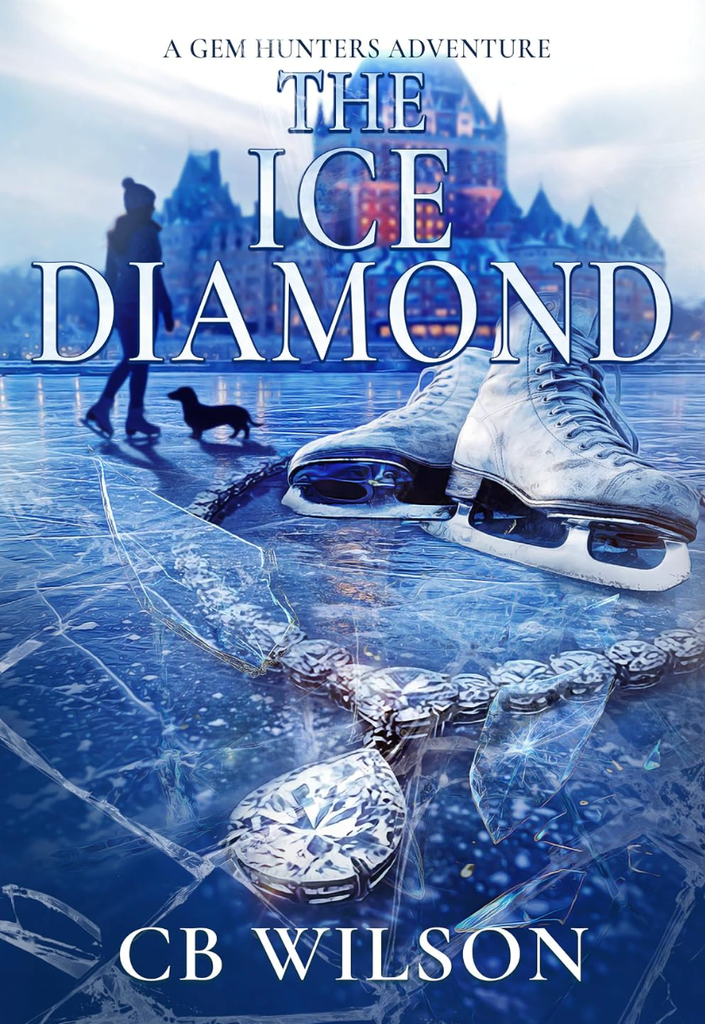
In her latest novel, The Ice Diamond, trouble arrives in an architectural form unlikely to appeal to Hunter: an ice hotel. Hunter dislikes the cold. Nevertheless, a priceless jewel vanishes from a locked room. Someone is murdered. And an Olympic ice princess proves less transparent than the accommodations. Familial betrayal complicates the investigation. Her father’s possible involvement adds an awkward dimension to the usual question of whom to trust.
For Cheryl, who prefers an ocean view, the setting required a departure from comfort. Learning that ice hotels have a limited season, she hurried to Quebec City during a March snowstorm. There she spent a night on a block of ice, enclosed in a mummy bag rated for minus thirty degrees, with only her eyes exposed. Research occasionally asks a novelist to interview an expert. This time, it asked her to become an uncomfortable exhibit.
The experience gave her something a photograph could not: the bodily knowledge of a place where even going to bed requires special equipment. It also established a useful sympathy between author and heroine. Neither had mistaken the assignment for a beach holiday.
Cheryl’s enduring expertise concerns what survives the thaw. A graduate of the Gemological Institute of America, she is interested in stones as objects with histories. To her, their beauty inseparable from the long journey that produced it. A diamond’s “inner fire,” she tells me, belongs to “what it was.” The stolen jewel consequently carries more than a price tag. Recovering it means retrieving a piece of the past.
Hunter’s assistant, Glimmer, approaches the matter through her nose. A diamond-sniffing dachshund, she combines professional usefulness with logistical convenience. Glimmer fits beneath an airline seat. Larger dogs may have the mining credentials, but the dachshund has generations of experience investigating holes and a perfect claim to the available legroom.
Glimmer also offers Hunter a steadier companionship than her human relationships generally provide. A kidnapping during her De Beers years and her father’s criminal legacy have left their marks. Cheryl allows those wounds to matter without making suffering the entire point.
She remains a romantic, partial to happy endings. There is something appealing about that preference in a hotel destined to melt. The walls cannot last. Perhaps trust can. Cheryl Wilson builds her frozen maze. She introduces the theft and the body. Then she leaves open the possibility that people, unlike their temporary lodgings, might emerge from the experience more whole.