

Caitlin Rother has spent much of her career in a shadowed space where fact and fear exchange coats. Before she became the New York Times bestselling author of seventeen books, she was an investigative reporter for daily newspapers. The profession is trained to distrust easy answers and to stay in the room after other people had decided they knew enough.
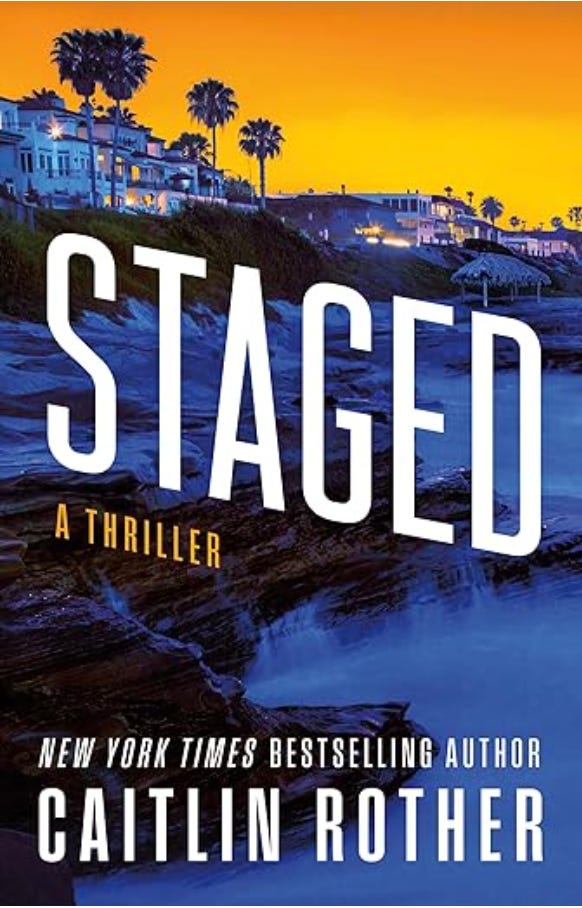
Her new novel, “Staged,” the second installment in the “Katrina & Goode” series, returns her to familiar terrain: San Diego, crime, corruption, grief, and the peculiar electricity generated when two damaged people recognize one another before they understand why. Katrina is an investigative reporter carrying the unsolved weight of her parents’ murder and her brother’s supposed suicide by overdose. Ken Goode is a homicide detective with his own private losses. They meet, naturally, in a bar in La Jolla, where chemistry arrives before professional reality can spoil the evening. By morning, he is working a death scene, and she is covering it with a reporter’s notebook. Romance, in Caitlin’s world, is never allowed the luxury of being uncomplicated.
That complication is the engine of “Staged.” Katrina and Goode are drawn together by shared trauma and pushed apart by ethics, procedure, danger, and the practical inconvenience of being watched by people who may want them dead. Around them, Caitlin builds a plot involving suspicious deaths, a secretive cabal, moneyed La Jolla investors, and a fictional sexual-enhancement drug whose approval becomes an object of desire, greed, and corruption. It could easily become an outrageous premise, yet it is made plausible by Caitlin’s native restraint. She understands that suspense is not merely the presence of bodies. It is the arrangement of pressure.
What distinguishes Caitlin’s fiction is the nonfiction that informs it. She has written about murder, addiction, suicide, mental illness, and the justice system. She has covered raids, interviewed law-enforcement sources. She has learned how official stories are constructed, challenged, and sometimes deliberately obscured. In “Staged,” she uses that machinery not as decoration but as building blocks that reveal a fascinating, addicting story.
Caitlin speaks of writing as persistence, but also as survival. When publishing slows, she writes another book. When rejection or delay arrives, she moves to the next manuscript. There is something almost nineteenth century about this discipline, though its anxieties are entirely contemporary. We writers exist in a world of shrinking media, fractured attention spans, disappearing social engagement, and the pressure to remain visible in a culture designed to distract.
For Caitlin Rother, success is both measurable and elusive. A bestseller list matters, but so does the next contract, the next reader, the next book that proves the last one was not an accident.
“Staged” seems born from that tension. It is a thriller about hidden crimes, but perhaps it’s also about the deeper mystery of how a writer keeps going, turning trauma into plot, experience into verisimilitude, and impatience into work. In the end, that work is the true reward.