

Hear the Conversation | Get the Book
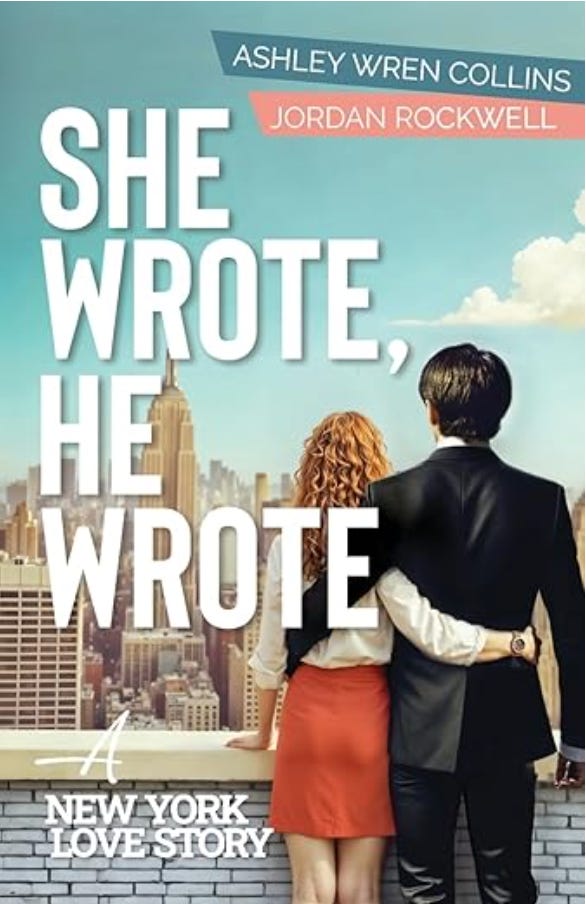
In the long tradition of New York love stories, the collaboration between Ashley Wren Collins and Jordan Rockwell arrives with a kind of self-awareness that feels both modern and faintly nostalgic. Their novel, SHE WROTE, HE WROTE: A New York Love Story, is not merely about romance, but about the mechanics of seeing and being seen, of telling a story from opposite sides of the same emotional street. It is, in essence, a duet.
The authors’ own origin story carries the improbable rhythm of a romantic comedy. They orbited each other for years, nearly meeting, missing, and re-missing again, until chance, that most New York of muses, intervened in a train station and later, on a beach. Their early encounters, marked by mismatched timing and comic misfires, seem less like prelude and more like proof of concept: that chemistry, when it finally ignites, often does so with the benefit of delay.
What distinguishes Ashley and Jordan’s collaboration is not simply that they share authorship, but that they divide perspective. The novel tells a single romance through dual narratives, allowing each writer to inhabit a character with autonomy while participating in a shared emotional architecture. Joanna, navigating the precarious terrain of creative ambition and questionable bosses, is Ashley’s domain, rendered with a sensitivity to rhythm, humor, and interiority. Logan, Jordan’s creation, moves through the expectations of wealth and the quiet anxieties of self-definition, his voice shaped by a structural precision that mirrors his professional world.
Their process reflects this division of labor. Jordan gravitates toward outline and scaffolding, the invisible geometry of story, while Ashley refines tone and flow, sanding down the edges until the narrative feels less constructed than discovered. It is a partnership built not on sameness but on complementary resistance. You feel a creative tension that, like the best relationships, depends on difference.
The novel itself draws freely from the cultural lineage of New York romance, with echoes of Sex and the City and the neurotic earnestness of How I Met Your Mother, though it resists imitation. Instead, it leans into a particular kind of emotional realism, one in which the stakes are simultaneously trivial and enormous. As Jordan told me, the search for “the one” may not determine the fate of the world, but within the psyche, it can feel indistinguishable from catastrophe.
There is, too, an ensemble sensibility at work. Secondary characters are not ornamental but essential, each carrying the residue of lived experience or imagined possibility. Ashley describes how a single overheard remark or fleeting observation can unfurl into a fully realized figure, a testament to the porous boundary between life and fiction.
Yet for all its structural cleverness, the novel’s ambitions remain modest in the most deliberate sense. Ashley Wren Collins and Jordan Rockwell are not interested in dismantling the genre so much as revitalizing its pleasures. They speak openly of wanting readers to laugh, to recognize themselves, to experience the joy of a well-told love story. It is a philosophy that places them closer to the populist exuberance of Raiders of the Lost Ark than the moral gravity of Schindler’s List, and they make no apologies for the distinction.
In the end, SHE WROTE, HE WROTE feels less like a single voice than a conversation, one that extends beyond its pages. It is a book about love, but also about collaboration itself, about the ways in which two perspectives can collide, diverge, and ultimately converge into something that neither could have produced alone.