

Hear the Conversation | Get the Book
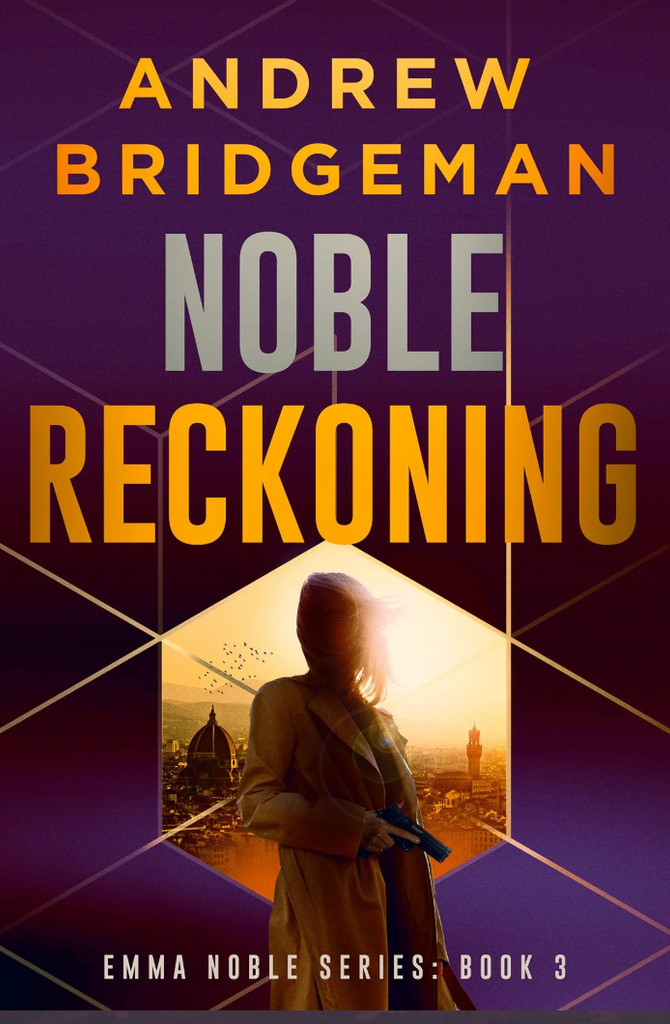
The aspiring novelist is often advised to acquire experience, although the advice rarely specifies when the acquiring should stop and the writing begin. Andrew Bridgeman played collegiate rugby, sang jazz, and worked in corporate insurance, accumulating the sort of résumé that looks like preparation. For decades, however, preparation remained his principal literary activity. Eventually, his wife supplied the editorial directive: “Write me a damn book.”
He was in his fifties. There are gentler ways to enter the profession, but perhaps none more effective.
His third novel, Noble Reckoning, begins with a communication problem of an unusually durable kind. Three weeks after Emma Noble buries an associate, she receives a message from the deceased. “Find Nadia,” it says. Death, apparently, has done little to improve the sender’s willingness to explain.
Nadia is a teenager caught in the orbit of an extremist. Emma, a former FBI agent, has neither a badge nor the institutional comforts that ordinarily accompany an international pursuit. Her search takes her from American bureaucratic intrigue to Florence, Italy, where the scenery offers little protection against the people who want Nadia dead.
Emma herself began as something of an interruption. While writing his debut, Fortunate Son, Andrew introduced her to give a seasoned federal investigator someone to talk to. The younger character proved insufficiently respectful of this supporting assignment. Brash, awkward, and possessed of a stubborn moral instinct, she gradually appropriated the story.
For a novelist inventing a woman thirty years younger than himself, the challenge was considerable. Andrew drew partly on his daughter’s vitality, proceeding through observation rather than any claim to privileged access. By the third book, Emma’s confidence has suffered the corrective attentions of experience. Discoveries involving her father have cost her an FBI career. She retains the impulse to intervene, now without the reassurance of belonging anywhere.
Andrew’s working habits suggest a similar tolerance for uncertainty. He calls himself a discovery writer, which means that the destination may become apparent only after the journey has acquired momentum. Research supplies necessary resistance. Marshals and former business-school classmates in federal law enforcement help him establish what an imagined scene might require.
Instinct, though, should not be confused with an absence of apprenticeship. Early in his development, Andrew took highlighters to Ken Follett paperbacks, examining the distribution of dialogue and interior thought. The exercise had something of the insurance professional’s respect for underlying structure: before assuming a risk, inspect how the thing is built.
The ambition behind all this is refreshingly specific. Andrew Bridgeman imagines a reader in a hospital waiting room late at night, needing somewhere else to be. Such a reader has little use for a novelist’s résumé, and less patience for evidence of how strenuously a book was researched.
What matters is whether the next page makes the room recede.
For all its pursuit and danger, Noble Reckoning rests on that intimate transaction. A writer who took decades to begin offers a stranger a few hours away. His wife’s instruction has become, in its way, an invitation to the reader.