

Hear the Conversation | Get the Book
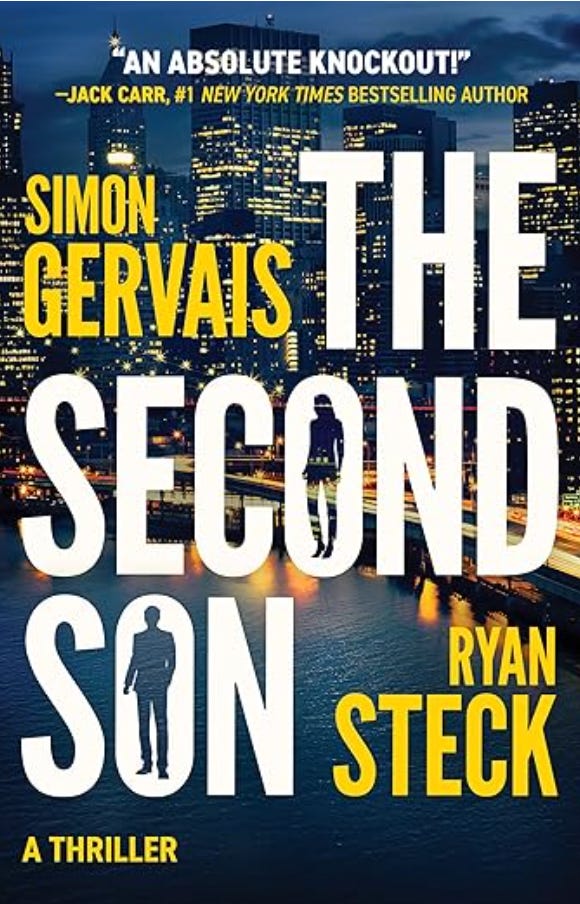
The thriller economy could be compared to a marketplace as meticulously tiered as the wine list at a Michelin-blessed restaurant in Manhattan. Readers have learned to expect the familiar. In The Second Son, the debut collaboration between Ryan Steck and Simon Gervais, two authors who have long occupied opposite ends of the genre’s tasting menu, something unexpected has happened: a blend that is both high-proof and quietly complex, buoyed by the strange chemistry of two writers who have, improbably, never been in the same room.
The story they’ve poured begins with a premise as old as espionage fiction itself, decanted into a decidedly contemporary glass. Chase Burke, their reluctant hero, is a former soldier who has retreated into the monastic quiet of a wine steward’s life. “Sommelier” is not the occupational cover one expects for a man trained to kill. In the hands of Simon (the ex-RCMP officer who writes action with the tensile authenticity of lived experience) and Ryan (critic, editor, evangelist of the thriller form), the contradiction is precisely the point. Burke is a man seeking absolution, one cork pull at a time.
Trouble arrives on schedule: a dead brother, smeared as a traitor; a Congresswoman Burke admires, ambushed; a careful life shattered like stemware on a tile floor. Soon, Burke is forced back into the bloodstream of violence he’d hoped to leave behind. Alongside him moves Alice Doyle, an NYPD detective whose professional grit is tempered by the bruised realities of motherhood, a character drawn not as a foil but as an equal, bearing her own quiet catalogue of compromises.
The Vintage of Collaboration, as Ryan and Simon jokingly refer to it, was shaped almost entirely at a distance. Ryan acknowledges the inherent solitude of writing, confessing that when someone grants him “five to eight hours of their life,” he feels an ethical burden to deliver. Simon echoes this, attributing their success to a mutual willingness to “leave ego at the door.” The trick is not avoiding disagreement but challenging it, offering competing ideas until the stronger one naturally rises.
This ethos, equal parts generosity and rigor, infuses the novel’s unlikely preoccupation with wine. Simon, midway through a sommelier course during the book’s drafting, insisted the protagonist’s palate matter. Ryan, who has publicly described himself as a recovering alcoholic and thus a stranger to wine’s charms, at first left bracketed notes where the tasting expertise should go. Soon he found himself researching tannins and terroirs, until, as Simon puts it, he had “done justice to a sommelier.” It is collaboration as alchemy: one writer filling the other’s gaps seamlessly.
If wine is the novel’s aroma, the twist is its structure. Ryan, whose career as a critic has seasoned him with thousands of plot turns, admits to a long-standing aspiration: to craft a “Harlan Coben–like” revelation, the kind that feels impossible until it suddenly becomes inevitable. “The best twists,” he notes, “are the ones you never saw, but once you do, they’re the only thing that makes sense.” Simon’s gift for big, disciplined action provides the counterweight. The result is a narrative that moves with the purposeful velocity of a well-trained operative but pauses just long enough to savor the emotional tannins underneath.
Burke himself is no super-soldier in the mold of Simon’s other protagonists or the ironclad heroes populating Ryan’s critical orbit. He is, as Ryan has said, a “second son,” forever eclipsed by the brighter, more accomplished sibling he has lost. His strength is not competence but obstinacy, a kind of moral stubbornness that grounds the story in something recognizably human. Doyle is rendered with similar restraint: a woman navigating the unglamorous friction between duty and domesticity, work-life imbalance stripped of cliché and presented in its raw, often unspoken form.
What Ryan and Simon are ultimately after is not reinvention but refinement. Simon Gervais articulates the joint mission with disarming clarity: to give readers “five to eight hours of pure entertainment,” a reprieve, a temporary loosening of life’s vise. That both men arrive at this goal from such different angles, one from the world of criticism and plot mechanics, the other from field experience and instinctive action, feels like the quiet miracle of the book.
When asked about a sequel, they speak with the confidence, and faint mischief, of co-conspirators already deep into their next operation. The Marked Son, is coming, and Ryan Steck promises that “truth is relative and truth bends and you might not even like the truth when you find it.”
The Second Son is many things, a thriller, a partnership experiment, a study in narrative. But above all, it is evidence that even in a genre defined by formula, the unexpected blend still exists. Two authors, writing apart, have somehow written closer together.