
Hear the Conversation | Get the Book
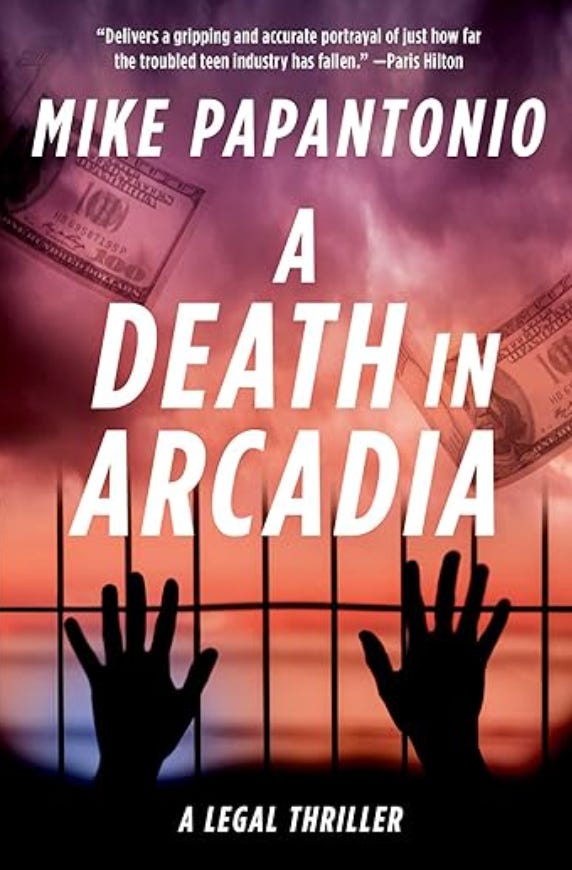
For Mike Papantonio, the veteran trial lawyer and broadcaster, the law is not a climate-controlled refuge but a contested terrain, one where victories are provisional and the emotional ledger rarely balances. His novel A Death in Arcadia proceeds from this disquiet, suggesting that while a courtroom can assign damages with impressive precision, it remains largely incapable of reckoning with grief.
The book centers on Deke, a trial lawyer whose reputation for ferocity has earned him the moniker of a bulldog, though the term feels almost genteel compared with the forces he confronts. When a fifteen-year-old boy is murdered inside a Florida juvenile detention facility, the case draws Deke into something more destabilizing than a legal puzzle. It becomes an excavation. The grim facts of the crime serve mainly as an aperture through which an older, more personal history begins to seep. Deke is pursued by a past he has sealed off so completely that even his daughter, Kara, who is also his law partner, encounters it as one might a locked room, palpable in its presence but resistant to entry.
Mike’s rendering of this terrain carries the authority of familiarity. Raised in Arcadia, Florida, a place he has described with a mixture of affection and clear-eyed appraisal, he writes with an instinct for the moral rot that can fester beneath ordinary surfaces. His career has been animated by what he once characterized as an innate intolerance for bullies. The phrase risks cliché, but in his telling, it acquires a kind of biological inevitability, as though outrage were less a stance than a reflex. In Arcadia, that reflex manifests in a persistent probing of systems that prefer opacity.
The novel’s emotional engine is rooted in a historical reality that resists fictional containment. The Dozier School for Boys, in Marianna, Florida, operated for a century as a state-sanctioned site of abuse, its crimes obscured by time and bureaucratic inertia. Even when the facts emerge, the law is not always positioned to respond. Statutes of limitations, those temporal boundaries that lend order to the legal system, can also function as barriers to accountability. By the time recognition arrives, the machinery of justice may already have shut down, leaving behind settlements that feel less like resolution than like gestures.
Yet the novel resists the pull of pure indictment. Its center of gravity lies elsewhere, in the relationship between Deke and Kara. She is not merely an extension of her father’s work but a rearticulation of it. Kara is a figure who inherits both Deke’s vocation and his unresolved burdens. Their partnership suggests a form of continuity that is at once professional and deeply personal, the transmission of purpose across generations. If the law cannot fully repair what has been broken, it can, at least, offer a framework in which that effort persists.
Mike Papantonio’s skepticism extends beyond the institutions he critiques to the cultural moment in which he writes. In an era increasingly populated by synthetic prose and algorithmic storytelling, he insists on the primacy of lived experience. A machine, he implies, may be able to organize facts or mimic cadence, but it cannot access the visceral knowledge that comes from standing in a courtroom and arguing on behalf of someone who has been harmed. What animates A Death in Arcadia is not simply its plot but its conviction. The desire to see justice done, however incomplete the outcome, remains stubbornly intact.
In fiction, as in life, that desire may be the closest thing to resolution available.