

Read the Conversation | Get the Book
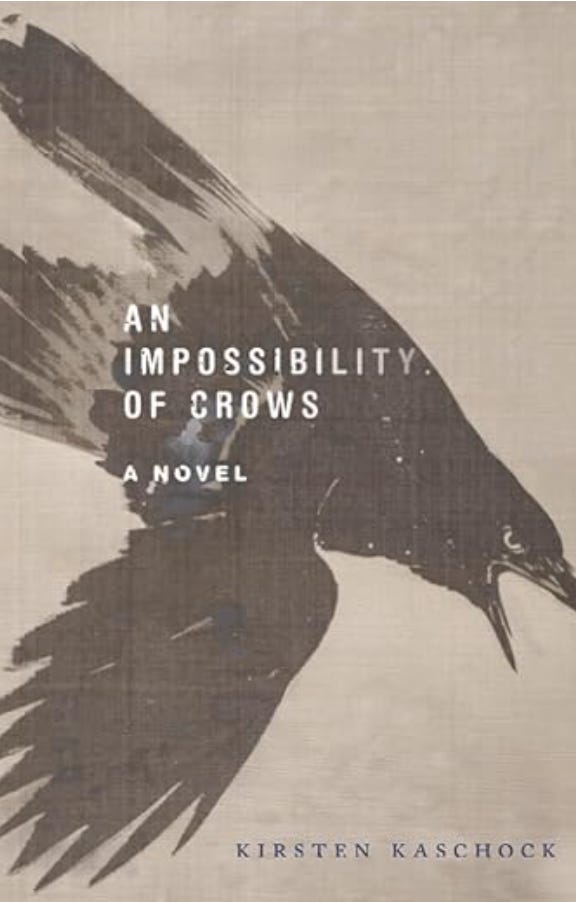
The creative evolution of Kirsten Kaschock is a study in graceful, if unsettling, pivots. A poet by training and a dancer by heritage, Kirsten has spent a career navigating the precise mechanics of the body and the lyrical economy of the line. Yet her novel, An Impossibility of Crows, suggests that beneath the poise of the pirouette lies a fascination with the grotesque. Described as “literary horror at its most unsettling,” the novel emerged not from a calculated shift in genre, but from the stubborn intrusion of a dream: a crow the size of a horse that refused to leave the author’s psyche until she “dealt” with it.
The result is a narrative that lives that uneasy space where devotion congeals into control. At the center of this darkness is Agnes, a protagonist who occupies the serrated intersection of logic and longing. A scientist by trade and a “mad scientist” by circumstance, Agnes is a woman stripped of the traditional markers of identity. When we meet her, she has lost her parents, her job, and her child. It is from this void of pandemic-era isolation that Agnes embarks on a breeding program. She attempts to “solve” her daughter Mina’s birth defect by engineering a gift of avian hypermobility.
Kirsten, a mother of three who began writing seriously only a week before her first son was born, brings a visceral, unsentimental perspective to the burdens of inheritance. The novel is steeped in the poetic yet obsessive history of South-Central Pennsylvania, the author’s own childhood home coupled with the silent, heavy legacy of the Vietnam War. In Agnes, Kirsten explores the ambivalence of parenthood, the terrifying reality that one can love deeply without knowing how to express that love, where the boundary of the self ends and the child begins.
The prose itself reflects this clinical detachment. Kirsten adopts a scientific tone for Agnes. She is abrupt, divided, and conquer-oriented. It is a voice that records actions rather than feelings, written in a journal format that allows the reader to follow a mind that stops just short of considering the feelings of others. Agnes is not a character designed to be loved. She is a character designed to be understood in all her brokenness.
An Impossibility of Crows functions as a Gothic reminder that, as Kirsten puts it, “the things we bury do not stay dead.” Her writing process is equally transformative. She views the first draft not as a finished product, but as “vomiting the clay,” a raw, necessary mess that only becomes art through the rigorous, “close to the bone” sculpting of revision. It is a dark, demanding philosophy, but for those who find relief in the shadows, Kirsten Kaschock’s work offers a necessary, pleasurable dread.