
Hear the Conversation | Get the Book
In the golden, smog-smudged light of nineteen-forties Los Angeles, the border between the silver screen and the sidewalk could feel as thin as a studio flat. Hollywood was a place where illusion didn’t merely happen. It was manufactured, lit, rehearsed, and sometimes, if you stood in the right spot outside the gate, it spilled into the street in the shape of a trench coat, a fedora, or a face you recognized before you could place it. For Elizabeth Crowens, a woman who has spent roughly twenty-five years navigating the jagged geography between New York’s grit and Hollywood’s gloss, that threshold is more than a setting. It is a vocation.
Elizabeth comes to fiction with the background of someone trained to see life as a sequence of compositions. She is a martial artist, a photojournalist, a former still photographer. She has worked the angles for publicists, which is another way of saying she has spent time in an industry devoted to directing attention. She has long been a chronicler of the frame. With her latest novel, Bye Bye Blackbird, she steps behind the curtain of the hard-boiled mystery to investigate the ghosts that linger around Hollywood’s most iconic sets.
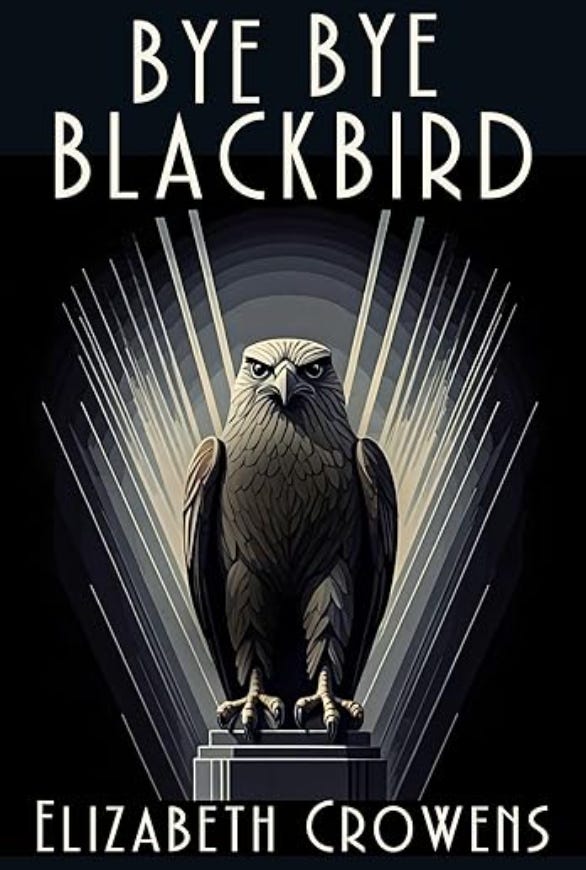
Blackbird is the second installment in her Babs Norman series, following Hollywood Hounds of the Baskervilles. If her debut was a canine-guided romp through the MGM lot, the new book is darker and more feather-strewn, as though the studio backlots have finally turned to face the shadows they’ve been throwing all along. The premise is delightfully self-aware: Humphrey Bogart, amid filming The Maltese Falcon, finds a mummified blackbird and an Egyptian canopic jar on his doorstep. The objects feel like props until they don’t. Fearing blackmail or worse, Bogart turns to Babs Norman and Guy Brent, two frustrated actors who have traded their headshots for private investigators’ badges.
Elizabeth’s protagonists are built from the era’s necessary disguises, the kind that weren’t about wardrobe so much as survival. Babs is a woman on the run from a violent, obsessive ex-husband in San Francisco. Guy is a closeted gay man in a time when an “out” life could mean the end of a career, and possibly the end of everything else. Together, they operate in a professional arrangement that depends on illusion as much as any movie. Guy often serves as the public face in a world that has little room for a female investigator. Babs does the work. It is a partnership shaped less by romance than by the rigid geometry of the period.
“They make a lot of mistakes,” Elizabeth admits, with a plotter’s pleasure. Unlike the polished detectives of noir legend, Babs and Guy are young, scrappy, and, in Blackbird, facing their first murder case. They don’t glide through danger with effortless competence. They misread people, miss clues, chase the wrong leads, and learn the rules the hard way, which is to say, the way most people learn anything real.
The narrative engine of Elizabeth’s work runs on an obsessive devotion to Tinseltown lore. She describes herself as a plotter, a writer who builds the scaffolding before the first scene appears. She can draft two hundred and fifty pages of research and outlines before writing a single chapter. Her shelves are packed with biographies and studio histories. She watches Turner Classic Movies with the eye of someone auditing a legend. When other viewers see glamour, she sees logistics. She watches how a cigarette is held, how a secretary crosses a room, how quickly a studio boss decides someone’s future.
It was in a biography of John Huston that she found the spark for Blackbird: a story of Huston playing a prank on his father, Walter, forcing him to repeat a death scene dozens of times until he was literally black and blue. The anecdote has the disturbing comedy of old Hollywood, where cruelty often travelled under the banner of genius. It also has the seed of a mystery: a set is a place where power can be exercised with a smile, and where “again” can be both direction and threat.
“When you hear stories like that,” Elizabet says, “you gotta use them.” The line feels like a credo. It also hints at her method. She treats Hollywood history not as trivia but as material evidence.
What gives Bye Bye Blackbird its charge is its devotion to chronology. The story culminates on December 7, 1941. As news of Pearl Harbor spreads and Roosevelt’s words begin to harden into history, the world changes shape in real time. Elizabeth notes with a researcher’s satisfaction that the next day a reader at Warner Brothers pulled a script titled Everybody Comes to Rick’s from the slush pile. It would become Casablanca, the film that now seems inevitable, as if it had always been waiting for its moment.
Elizabeth’s own career has involved its share of reinvention. She speaks candidly about the distance between the “experimental, artsy” world of New York film school, where teachers leaned toward the avant-garde factory of Andy Warhol, and the commercial demands of mystery fiction, which requires discipline as much as inspiration. She calls publishing a “tough game,” and she has played it in more than one league, moving from small presses to reclaiming her rights, and eventually into self-publishing with her Time Travel Professor series. There is a practical resilience in that trajectory, the kind that rarely appears in romantic myths about writers, but that tends to matter more than talent.
If Bye Bye Blackbird were to reach the screen today, Elizabeth has a casting call ready: Daisy Ridley for the resilient Babs, Zac Efron for the polished Guy. It’s a modern pairing, almost deliberately so, as though Crowens were reminding us that the best way to keep the past alive is not to preserve it under glass, but to let it move again. Her fiction remains caught in the orbit of old Hollywood, but it is not nostalgic in the simple sense. The glamour is there, but so are the limits that glamour required, and the lives that had to be hidden to keep the picture smooth.
In Elizabeth Crowens’s Los Angeles, the movies do not merely reflect the world. They are part of the machinery that builds it. The sets stand, the cameras roll, and somewhere, just off frame, the truth waits for its close-up.