

Hear the Conversation | Get the Book
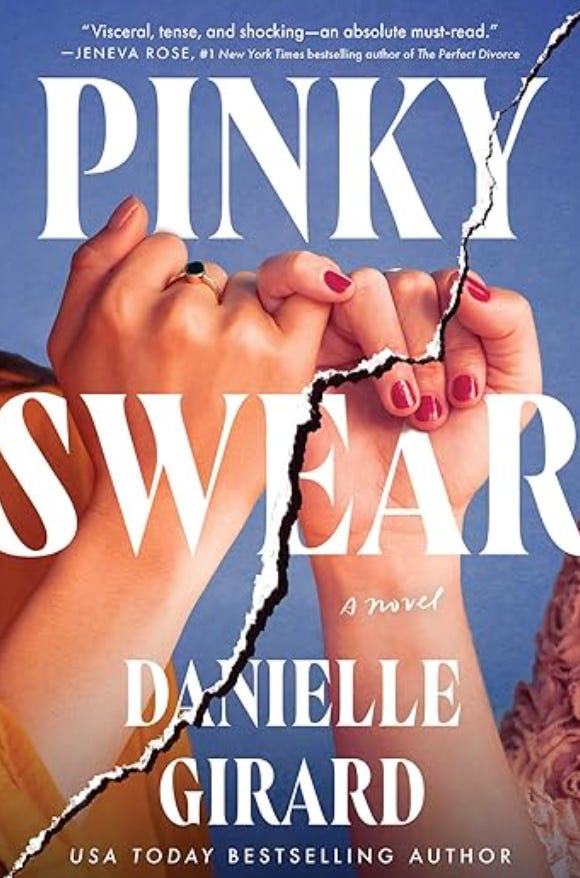
In the American imagination, the villain is often a matter of geometry, clean angles, hard lines, a silhouette so sharply drawn as to be unmistakable. Nowhere is this more evident than in the Disney canon, where evil is lacquered to a gleam, an aesthetic of pure malice unbothered by the ambiguities of human behavior. It is precisely this symmetry, this moral Origami, that Danielle Girard has spent twenty-five years unlearning.
In the world as she knows it, and as she writes it, most people live in the slanted middle, their goodness and their failings distributed in proportions that shift with the hour. Perhaps we are seventy percent generous, thirty percent selfish; perhaps the reverse. Danielle’s new novel, Pinky Swear, occupies this unsteady terrain, tracing the imperceptible slide between devotion and delusion, between the choices that make a life and the ones that undo it.
There is an irony in the fact that Danielle’s career, on the surface, appears so tidily symmetrical. She sold her first novel while pregnant with her daughter, typing with the urgency of someone straddling impending motherhood and a job in finance, a woman stitching a creative life into the narrow seams of an already full existence. Seventeen books later, she finds herself writing from the other side of the domestic arc. If the early work grew from the soil of family-making, Pinky Swear rose from the ashes of its collapse.
Danielle describes the implosion of her thirty-year marriage. The details, she notes, belonged more to a daytime serial than to a modern thriller: an unfaithful husband and the eerie estrangement that settles across a dinner table when two people realize they have ceased to know one another. “If he didn’t expect a book to come of it,” she said, “then he wasn’t thinking very clearly.”
But Pinky Swear is no act of literary vengeance. Nor is it a return to the procedural rhythms she once mastered. It is, instead, a kind of emotional archeology. The premise pivots on a primal longing: Lexi, yearning for a child, accepts the offer of Mara, an distanced friend fleeing an abusive marriage, to serve as her surrogate. Then, days before the birth, Mara vanishes. The disappearance is not merely a plot device but a rupture in the architecture of trust, a collapse that reverberates far beyond the missing woman.
The Danielle Girard who might once have attacked this narrative as a high-speed pursuit, “vomiting on the page,” as she puts it, has yielded to a quieter, more patient version of herself. She lives in a Montana landscape where winter has a way of intruding into one’s inner life, she writes with the steadiness of someone who has learned to listen to silence. The novel lingers not in the chase, but in the stillness: the untouched crib, the unanswered call, the suffocating dread of waiting for a door that doesn’t open. The space between events has become, for her, the event.
This evolution is mirrored by the upheaval in her professional world. The publishing industry, Danielle says, is in a paradoxical state, an arena where it has never been easier to publish and never harder to sell. In the wake of her divorce, she parted ways with her longtime agent. Starting over at mid-career is the sort of gamble few writers survive. Yet she emerged with a new home at Atria Books, her novel sold at auction, the kind of improbable comeback that literary lore tends to romanticize after the fact.
Critics have observed a kind of doubleness in Pinky Swear: its narrative induces a creeping dread, yet its prose is composed with such precision that the reader is compelled to savor it, even as the dread deepens. The threat comes not from a cartoon villain but from something more mundane and therefore more frightening: the ordinary betrayals that erode our sense of safety. The book’s central question, “How well do we truly know the people we love?” is one Danielle herself cannot escape. It is the refusal to sort people into neat moral categories that gives her antagonists their disquieting realism.
In the end, Danielle considers Pinky Swear an exploration of forgiveness, the kind that leaves scars. She describes the process of writing as akin to “driving in the fog,” trusting that the road will reveal itself in increments no longer than a single headlight beam. It is an apt metaphor for an artist who has survived personal rupture, professional reinvention, and the chilly solitude of reinvention. There is a moment in our conversation when she laughs and says she is “wasted for the corporate world.” It is a laugh that carries both liberation and resignation.
Writing, for Danielle Girard, is no longer something she fits around life. It has become the means by which she navigates it, the way she moves through the fog, one necessary line at a time. And Pinky Swear emerges as another riveting reading experience, troubling, addictive and ultimately a story you won’t be able to put down.