
Hear the Conversation | Get the Book
In the manicured, pastel suburbs of Brisbane, Australia, lives a family of animated Blue Heelers who have, become a moral yardstick for contemporary parenting. Bluey, a seven-minute cartoon ostensibly made for preschoolers, has evolved into a weekly referendum on adult inadequacy. Bandit, the father, approaches imaginary play with the stamina of an endurance athlete; Chilli, the mother, dispenses wisdom and patience with a calm that borders on the metaphysical. For many parents, the experience is less entertainment than quiet self-indictment.
It was in a Facebook group devoted to this canine utopia that Christopher Mannino, author, former theatre teacher, and professional observer of human behavior, encountered the provocation that would shape his latest book. A mother had posted a furious denunciation of the show, arguing that its portrayal of parenting was not merely unrealistic but actively harmful. Chris was amused; his wife, less so. The problem, she suggested, was not realism but misclassification. Bluey wasn’t depicting ideal parenting, it was depicting improvisation.
The distinction mattered. Chris, who studied literature and theatre in the United States and at Oxford and now lives in Malta with his family, recognized it immediately. The Heeler parents weren’t operating from a playbook of best practices; they were responding, moment by moment, to the offers their children made. They weren’t parenting in the clinical sense. They were doing long-form improv.
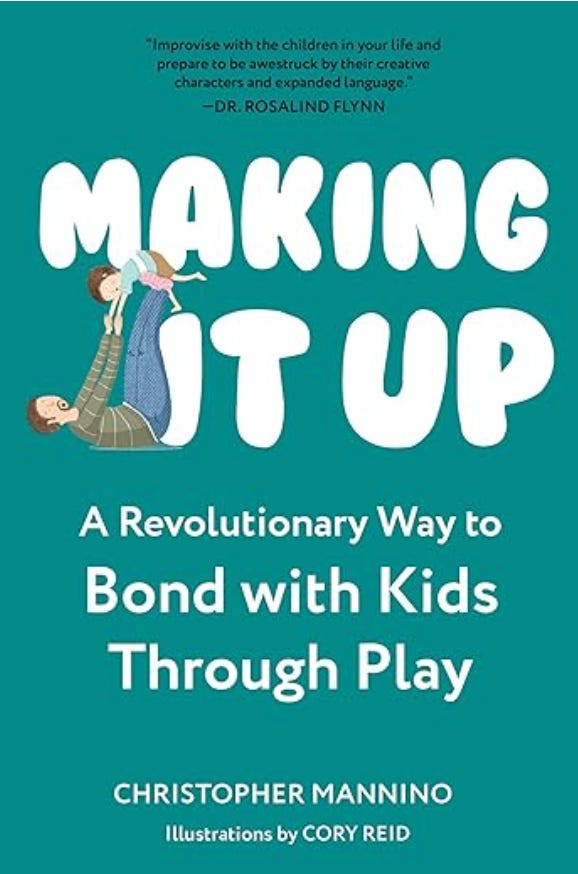
The result of this realization is Making It Up: A Revolutionary Way to Bond with Kids Through Play, a book that positions parenting less as a behavioral science and more as a collaborative performance. Chris’s premise is both disarmingly modest and quietly radical: the most meaningful interactions between parents and children do not require expertise, equipment, or enlightenment, only presence, responsiveness, and a willingness to follow the scene where it leads.
At the center of Chris’s argument is a principle familiar to anyone who has ever set foot in an acting class: “Yes, and.” In improvisational theatre, the phrase functions as both rule and ethos. To reject a partner’s premise is to derail the scene; to accept it and build upon it is to let something alive unfold. If one actor declares herself a doctor and the other insists she is, in fact, a plumber, the fiction collapses under the weight of contradiction.
In domestic life, however, contradiction is reflexive. A child barrels into the kitchen announcing he is a dragon; the parent, scanning the stove, replies that he is blocking the pasta. The denial is practical, efficient, and entirely reasonable. It is also, Chris suggests, a missed opportunity. By saying “Yes”, you are a dragon, and “And”, this kitchen is your cave, the parent enters the child’s inner world rather than policing its borders.
This, Chris argues, is not indulgence but attunement. To “Yes, and” a child is to practice a form of active listening that affirms imagination as a legitimate mode of experience. The payoff is not merely emotional but neurological: brief, intense moments of shared play forge connections that linger far longer than the interaction itself. Crucially, Chris is realistic about adult limitations. He does not prescribe hours of elaborate fantasy but ten-minute intervals of undivided attention.
Still, even ten minutes can feel insurmountable after a workday spent absorbing other people’s demands. To address this, Chris borrows another tool from the theatre, this one rooted in the Stanislavski system of method acting. Actors, seeking emotional authenticity. They often recall personal memories to access specific feelings onstage. Chris adapts this technique for parents, calling it the “Anchor.”
An Anchor is a sensory memory, vivid, embodied, emotionally charged, that a parent can summon to regulate themselves before entering play. Chris recounts discovering his own Anchor at the Wizarding World of Harry Potter in Orlando, where his young son froze in terror before a fire-breathing dragon statue. As the child clutched his leg, Chris felt a rush of competence and protectiveness so acute it bordered on physical pain. The memory, he realized, could be recalled later, in quieter but more trying moments, to steady himself, to arrive at playtime as a collaborator rather than a casualty of the day.
What distinguishes Making It Up from the crowded shelves of parenting literature, an ecosystem populated by celebrity confessions and diagnostic frameworks, is its refusal to professionalize intimacy. Chris does not offer credentials or guarantees. He writes instead as a father who spent seven years at home with his children and noticed that the “inner child” so often invoked in self-help culture is not lost but suppressed, crowded out by efficiency and adult urgency.
In an era that increasingly mistakes proximity for connection, parents scrolling through phones on the sidelines of playgrounds, physically present but psychologically elsewhere, Christopher Mannino’s approach feels almost subversive. Making It Up: A Revolutionary Way to Bond with Kids Through Play suggests that childhood play does not need to be managed, optimized, or documented. It needs, quite simply, a partner.