
Hear the Conversation | Get the Book
The hallways of the Department of Justice suggest permanence. The floors shine with the sort of institutional polish that implies continuity rather than creativity. One imagines ambition moving briskly there, not imagination. Yet for Chad Boudreaux, who reported to Main Justice on September 10, 2001, the building would become less a monument to order than an antechamber to narrative possibility.
History has a way of consecrating one’s first day on the job. By the next morning, the abstractions of federal service were pierced by catastrophe, and the marble corridors became conduits for urgency. Boudreaux would go on to spend decades in the overlapping spheres of homeland security and defense leadership, inhabiting a professional world defined by classified briefings and calibrated language. From that terrain he has fashioned a second vocation. He writes thrillers.
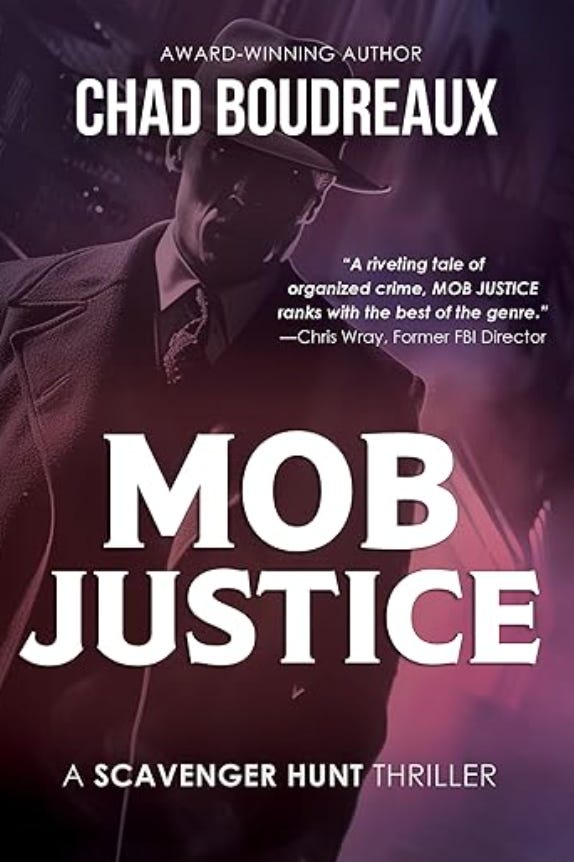
His latest novel, Mob Justice, follows Scavenger Hunt, and returns to Blake Hudson, a Department of Justice attorney whose résumé has already included the global angst of counterterrorism. This time, however, Hudson is dispatched not to a distant theater but to Chicago, where violence carries a genealogy and loyalty is a form of inheritance. Boudreaux’s Chicago is less a skyline than a manuscript written, erased, and written over again. The old syndicates. The whispered names. The suggestion that the past never fully vacates the premises.
The novel invokes the lingering aura of Chicago Outfit and its Prohibition era adversaries, including the North Side Gang. These are not presented as sepia toned relics but as structural influences, like rebar embedded in concrete. Boudreaux is drawn to gray areas, to the space where the law’s formal architecture meets the improvisations of survival.
The book’s most arresting confrontation unfolds not in an alley but at a steakhouse table. Across from Hudson sits Enzo, a former clerk to the Supreme Court who has chosen, with unnerving deliberation, to become a mob consigliere. The pivot is implausible until one recalls how proximity to power can recalibrate a conscience. Enzo is the kind of antagonist who speaks in citations rather than threats.
Boudreaux’s fidelity to procedure is the product of deep research. When he found his depiction of a wiretap lacking the proper cadence, he consulted former agents from the Federal Bureau of Investigation to revise the dialogue. There is, he notes, a vocabulary to surveillance. Acronyms carry weight. Shorthand encodes hierarchy. The result is prose that moves with documentary restraint. One senses the author resisting melodrama in favor of plausibility, as though aware that the real world has already supplied enough spectacle.
Now a senior executive in the private sector, Boudreaux approaches fiction as both craft and a shift from his real-world life. He has expressed little interest in attaching his protagonist to a marquee star. Someone untested would do. Someone whose face does not arrive preloaded with expectation. Blake Hudson is meant to be earnest, even naive. Good hearted in a system that rewards calculation.
In Mob Justice, loyalty and betrayal function as twin currencies, exchanged across boardrooms and backrooms alike. The political weather shifts. Alliances harden and dissolve. What remains is the individual, navigating institutions that are at once grand and fragile. Chad Boudreaux’s fiction suggests that beneath the marble and the memos, the Department of Justice contains something irreducibly human. Not hallucinogenic, perhaps. But charged.