

Hear the Conversation | Get the Book
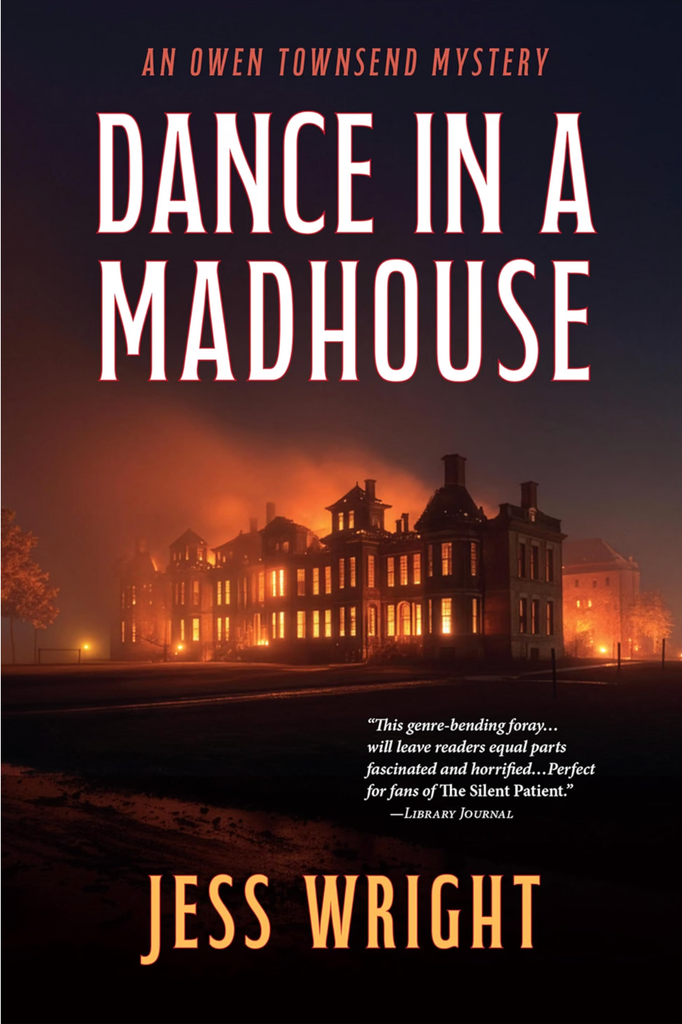
An asylum can present a difficulty for the detective novelist. Once a person has been declared unreliable, whom does he tell when something is wrong? For Owen, the central figure in Dr. Jess Wright’s fascinating Dance in a Madhouse, the problem is more than theoretical. Confined after a violent episode brought on by fever, he recovers his faculties inside an institution where recovery does not necessarily confer credibility. His suspicions may be symptoms. They may also be correct.
Dr. Wright is a professor at the University of Louisville’s medical school and a pioneer in cognitive behavioral therapy. He has spent much of his career helping people examine the stories their minds tell them. Fiction offers a variation on that theme. The reader, like the patient, must consider the evidence while remaining alert to the possibility that an apparently reasonable explanation could be doing considerable damage.
The novel’s beginnings were in a collection of family letters. A poet friend discovered correspondence written by her great-grandfather, Peter Taft, a brother of the future President William Howard Taft. After a psychotic episode associated with typhoid fever, Peter was committed to an asylum. The family’s concern for its social standing consigned him to an institutional life from which he never emerged.
There is something especially unsettling about encountering such a fate in correspondence. A letter assumes a recipient, someone on the outside who might understand, intervene, or simply write back. Preserved across generations, it becomes evidence of a person whom an institution, and perhaps a family, found easier to classify than to hear.
Dr. Wright transforms that historical predicament into the fictional Fairmount Lodge, where Owen must negotiate the peculiar authority of people empowered to explain him to himself. The suspense depends on an imbalance familiar beyond psychiatry. One party makes an allegation. The other decides whether the allegation proves the speaker’s incapacity.
The title comes from a George Bellows lithograph depicting an asylum dance. Its unsettling conjunction of festivity and confinement supplies Dr. Wright with an image for the institution itself. An evening’s entertainment can look different depending on whether one is free to leave.
Dr. Wright finds medical experience most useful in the attention he gives his characters. Celeste, an opera singer suffering after postpartum psychosis, has a history and an identity that exceed her illness. Inspector Brumbaugh, a skeptical Pennsylvania investigator, gradually recognizes Owen’s intelligence. Recognition distinguishes the man from the account maintained about him.
Before medicine, Dr. Wright studied theater and art history. His fiction returns to those interests without abandoning the consulting room’s central challenge. Both the novelist and the psychiatrist encounter people whose explanations are incomplete. Their fears contain mixtures of distortion and accurate perception.
Dance in a Madhouse finds its deepest unease in the possibility that sanity may be insufficient to secure one’s freedom. Owen needs more than a clear mind. He needs another person willing to take it seriously. Beneath the historical mystery Dr. Jess Wright explores a troubling question. What happens when the people responsible for listening have already decided what every word must mean?