

Hear the Conversation | Get the Book
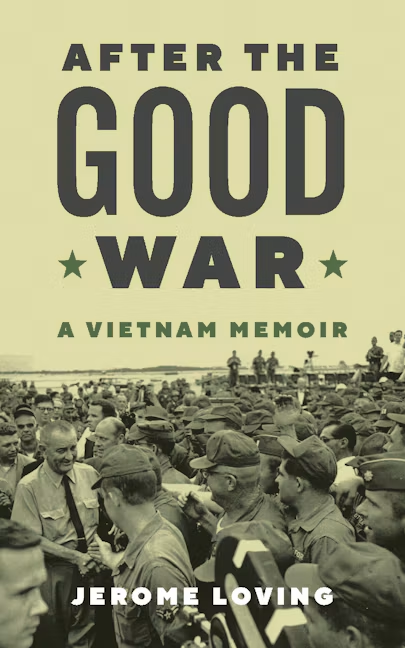
In 1966, Jerome Loving returned from Vietnam to a country that seemed scarcely to have noticed his absence. There had been no victory, and there would be no homecoming of the sort associated with the Second World War, which he calls “the good war.” America was carrying on. For someone who had spent nearly nine months in Saigon and Cam Ranh Bay, its ordinary routines could seem a peculiar response to a war.
Loving had arrived in Southeast Asia as a twenty-four-year-old college graduate and commissioned naval officer. Now eighty-four, and a distinguished professor emeritus of American literature, he has turned to a subject he long preferred to leave alone. His memoir, “After the Good War,” draws on a wartime diary and letters to his wife, documents preserved by a young man who could not yet know how much of his subsequent life would be devoted to other people’s words.
The manuscript itself spent years put away. Loving wrote it more than a decade ago as part of an autobiography, then boxed it up. A colleague eventually persuaded him to publish it. For a scholar accustomed to reconstructing lives from letters and surviving papers, the materials were familiar. The difficulty lay in their belonging to him.
His Vietnam was a place of ammunition ships, unfamiliar streets, and precautions that gradually acquired the force of habit. Assigned to protect ships in the harbor, he avoided front-line combat. But distance from the fighting offered little relief from the expectation that something might happen. Bounties had been placed on American officers. In a Saigon hotel, he slept with a .38-caliber and a .25-caliber weapon beneath his pillow. By the door, he balanced two stacked glasses, a makeshift alarm whose usefulness depended on his being ready to act when they fell.
“If my mother had opened that door, I would’ve shot her,” he told me.
The sentence is startling partly because it leaves so little room for interpretation. Fear had reduced the distinction between a visitor and an intruder to the sound of a door opening.
Back in the United States, Loving found a productive means of putting the experience behind him. The G.I. Bill paid for graduate school. Five and a half years of study led to a career as a scholar of Walt Whitman and Mark Twain, with appointments and travels that took him to Duke, the Sorbonne, and Leningrad. There was work to do, and the work concerned lives sufficiently distant from his own.
Still, American literature offered no permanent escape from American wars. Whitman had spent the Civil War visiting military hospitals, tending to wounded men and writing letters to bereaved mothers. Twain’s brief service in a Confederate militia preceded his later opposition to American intervention in Asia. In both writers, Loving encountered the uneasy passage from national ideals to national conduct. He came to regard the Vietnam era as a kind of American civil war, its divisions running through streets and classrooms at home while the fighting continued abroad.
He describes his memoir as a lament. Its losses include the nearly sixty thousand Americans who died, and the survivors whose return did not restore the lives they had left. Loving’s brother-in-law, a Marine, came home unable to find his footing again. He died at fifty-four. His experience gives a particular face to a consequence that casualty figures cannot adequately record.
Loving was able to build a life after Vietnam, a substantial and distinguished one. That achievement lends the memoir its quieter sorrow. The diary and letters survived his determination to move on. At eighty-four, he has returned to the young officer who placed glasses beside a hotel door and tried to sleep. The war ended long ago. Those glasses are still waiting to fall.