

Hear the Conversation | Get the Book
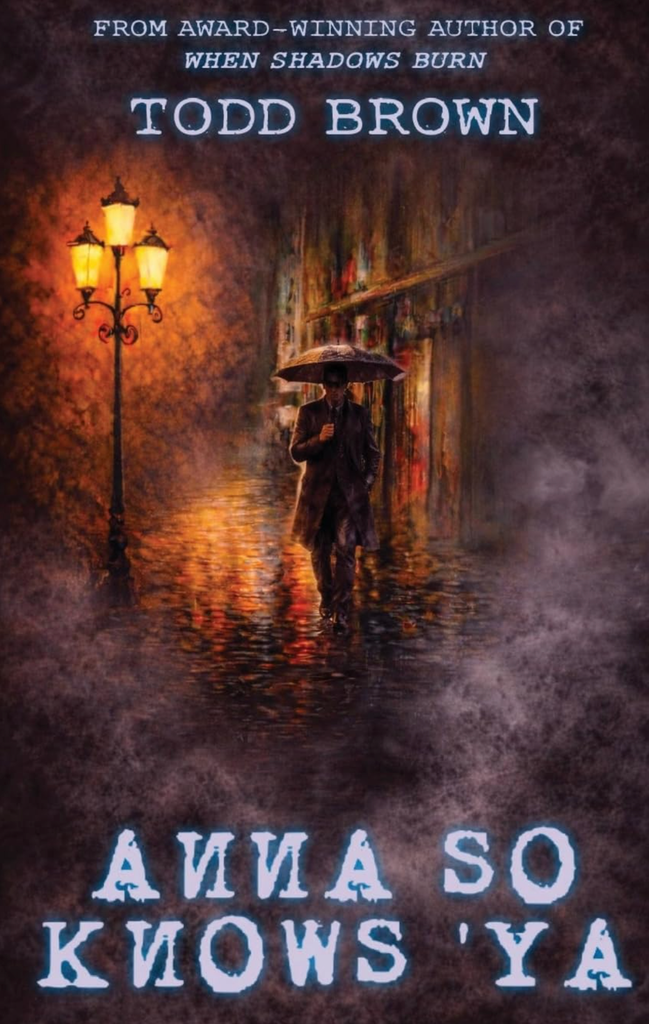
A crime reporter makes an awkward tenant for a haunted mind. His occupation requires evidence, attribution, the reassuring distinction between what happened and what somebody believes happened. But give him a suspicious sound and certainty may become a professional liability. He knows how to assemble a story. The difficulty is knowing when to stop.
This is the predicament Todd Brown has devised for John Simmons, the journalist at the center of his psychological thriller, “Anna So Knows ’Ya.” Todd describes a novel concerned with the unstable border between investigation and obsession where his protagonist encounters Anna So. Then, a mysterious man in a dark hat appears. Soon, ordinary behavior seems freighted with private significance. Perhaps someone is pursuing John. Perhaps his mind has become a persuasive source.
Todd came to fiction through sociology, a discipline accustomed to looking beneath individual behavior for larger arrangements. His debut, “When Shadows Burn,” accommodated twenty-five characters. It reached the Eric Hoffer Grand Prize shortlist. For his second novel, he imposed a different experiment. Three characters. A compressed span of time. Very little room to breathe. The change resembles moving from a crowded intersection into an elevator stuck between floors.
Within that enclosure, a sentence can alter the atmospheric pressure. Todd plants small destabilizing details, allowing readers to inhabit John’s grief and paranoia without furnishing them with a reliable exit. The suspense depends on interpretation. What does a sound mean? What does a stranger want? At what point does attentiveness become a form of captivity?
For Todd, who identifies as being on the autism spectrum, the distance between intention and reception is a subject of particular interest. A speaker sends one message. A listener receives another. Between them lies the territory in which misunderstandings acquire consequences. John and Anna’s relationship develops on this uncertain ground, where language offers neither party the protection it seems to promise.
There is a more dependable exchange at Todd’s breakfast table. His wife reads the latest pages, awarding smiley faces and check marks with the practical authority of an elementary-school teacher. Together, they watch true crime, an education in how arrangement can make the same material suggest different conclusions. Her morning assessments help keep his fictional uncertainty from becoming an author’s confusion.
Beneath the menace is Todd’s suspicion that people will accept a frightening explanation more readily than no explanation at all. Randomness provides little comfort. A pattern, even a sinister one, supplies the relief of understanding.
His account of morality is similarly resistant to tidy classification. It is less an on-off switch than a dial. Cruelty, fear, and decency can occupy the same person, their proportions shifting with circumstance.