

Hear the Conversation | Get the Book
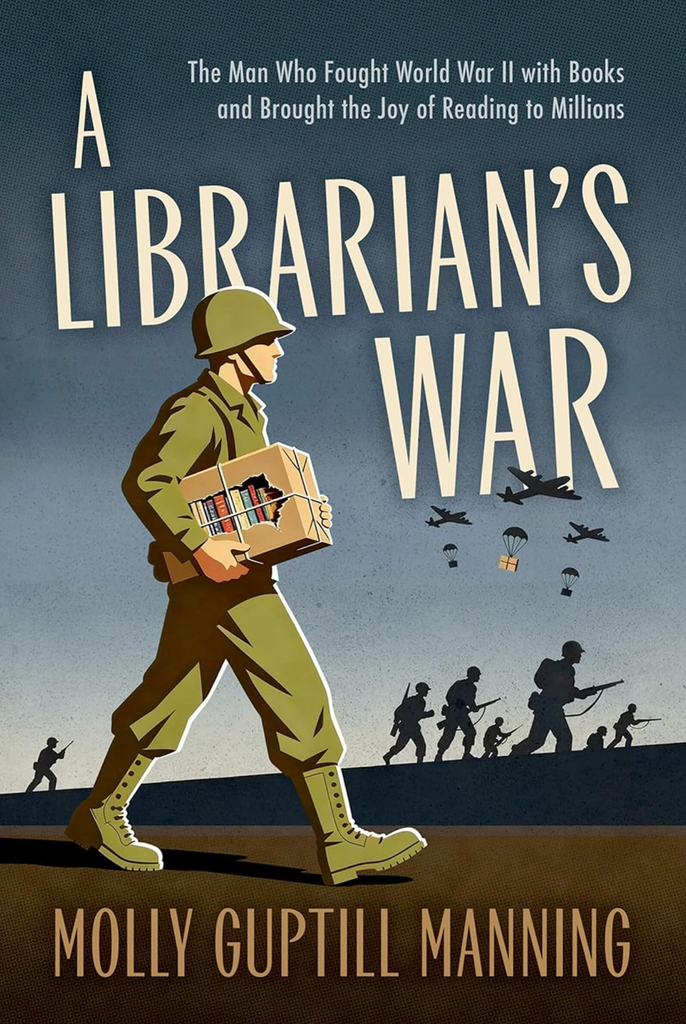
In the winter of 1944, Ray Trautman, a librarian by profession and temperament, found himself in an incredible situation. Sent to Europe by General Dwight D. Eisenhower to determine what American soldiers wanted to read, he wandered into the German offensive that would become the Battle of the Bulge.
From the forest came a group of stranded American soldiers, many without weapons. All without a commander. Trautman, by virtue of rank rather than combat experience, was placed in the lead. Faced with an approaching column of German tanks, he helped the men devise improvised weapons from whatever could be found. He also made them a promise: survive, and he would get them books.
The scene has the improbable neatness of a Hollywood script. In fact, it belongs to a life spent treating books not as decorative objects but as essential equipment. That life is the subject of Molly Guptill Manning’s A Librarian’s War: The Man Who Fought World War II with Books and Brought the Joy of Reading to Millions. Manning, a law professor and historian, first encountered Trautman while researching another tome, When Books Went to War. His name kept popping up.
With publication, Trautman’s family reached out, giving Professor Manning access to carefully preserved papers. In A Librarian’s War, she reconstructs the career of a man whose influence can still be found in nearly every paperback rack, audiobook library, and military reading room in America.
Trautman grew up in Mowrystown, Ohio, a community of about two hundred people and, by his recollection, far too few books. His hunger for information eventually carried him through college during the Depression and into the Civilian Conservation Corps, where he worked as an educational adviser. Many of the young men he met had left school to work on farms. Trautman did not scold them for what they had missed. He asked what interested them and built literacy programs around the answer.
When America entered the Second World War, military officials worried about morale. Trautman was appointed chief librarian of the United States Army. He understood that a soldier might require escape as urgently as instruction. The problem was weight. An infantryman already carried more than enough, and a hardcover novel was unlikely to outrank ammunition.
Trautman worked with W. W. Norton and others to persuade publishers to produce small, lightweight paperbacks known as Armed Services Editions. They were designed to fit into a uniform pocket and distributed by the millions. By the war’s end, 123 million copies had been produced. Soldiers who had rarely read for pleasure became devoted readers. Publishers, observing this vast new audience, discovered that the paperback was not merely a cheap substitute for a book. It was the future of the business.
Trautman also defended the freedom to read. When a general attempted to remove Ernest Hemingway’s stories, Trautman resisted, citing a wounded soldier who had found comfort in a Hemingway character crying beneath his bedsheets. The story had given the man permission, however briefly, to be afraid.
Returning soldiers became a generation of bookworms. Sales skyrocketed. Libraries flourished. And Trautman turned his attention back to expanding literacy and a focus on blind and visually impaired readers. He studied braille production and argued that a new idea called audiobooks should be performed by trained actors, not recited in the dutiful monotone of civic obligation.
Molly Guptill Manning’s protagonist believed that literature could restore privacy, courage, and dignity, even in a barracks or hospital ward. His great conviction was simple: no one should be denied the story that might help them survive.
He may never have been trained in combat, but Ray Trautman’s contribution to the war effort and American literacy is one of the most inspiring stories of The Greatest Generation. A tale of how one individual’s efforts can ripple across the generations, in the unassuming, humble, yet tenacious way we venerate our greatest heroes.