
Hear the Conversation | Get the Book
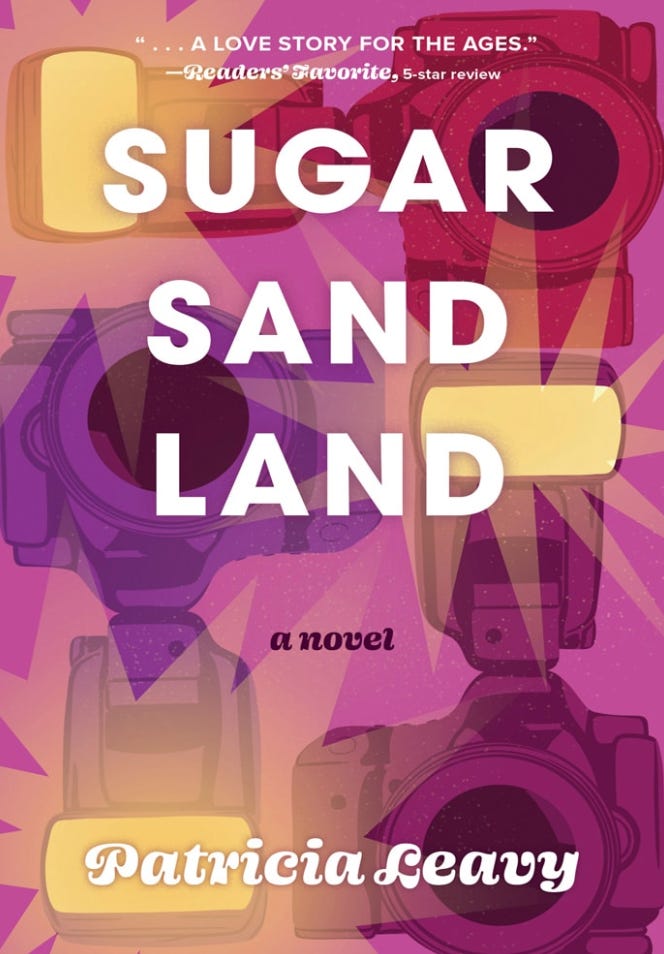
Dr. Patricia Leavy has spent much of her professional life trespassing across borders that other people regard as fixed. Trained as a sociologist, she became a novelist. As an academic, she helped pioneer arts-based research, arguing that scholarship need not remain trapped behind the walls of the university. As a writer, she has produced more than fifty books and accumulated an improbable number of awards. Her newest novel, Sugar Sand Land, is her twenty-fifth work of fiction and, she has said, her favorite. She saved it for the milestone.
At first glance, the book arrives dressed for vacation. It is a beach read, romantic and sunny, “sweet, tender, and sexy.” But Dr. Leavy has tucked a set of contemporary anxieties into the beach bag. The novel is concerned with celebrity, public disgrace, loneliness, moral certainty, and the uneasy difference between who we are and the version of ourselves we display to strangers.
Its central couple is designed to make the reader squirm. Emerson Blue is twenty-eight and one of the most followed influencers in the world, a woman whose public image has become both profession and identity. Ren Walker is twenty years older, a Grammy-winning country star who has disappeared from public life after allegations of sexual misconduct. Their romance carries enough complications to fuel several books, but Dr. Leavy is less interested in resolving those complications than in making us dwell within them.
The age difference matters. So does Ren’s past. Dr. Leavy has constructed the relationship to resist the increasingly popular habit of sorting people into moral categories at first sight. In a culture organized around instantaneous judgment, she is interested in the slower business of uncertainty.
Social media provides the novel’s natural backdrop because it has turned judgment into a participatory sport. It also offers one of modern life’s more persuasive illusions, the idea that visibility produces intimacy. We see one another constantly and know one another less. A teenager scrolling through photographs of flawless classmates may understand, intellectually, that the images are curated. Emotionally, the distinction can be harder to sustain. Someone else’s edited exterior begins to feel like evidence against our unedited life.
Dr. Leavy knows something about the cost of self-consciousness. Intensely shy as a child and often bullied, she initially avoided the arts because rejection seemed unbearable. Eventually, the impulse she feared became central to her work. By combining research and storytelling, she found a way to make scholarship more emotionally legible and, perhaps, more human.
That same impulse animates Sugar Sand Land. Dr. Leavy’s deeper subject is compassion, particularly the uncomfortable kind. Writing fiction has taught her, she tells me, to love characters who are damaged, contradictory, and sometimes difficult to defend. She is wary of cancel culture and the speed with which accusation can become verdict, even as she remains supportive of the Me Too movement and of women speaking openly about abuse.
This is difficult territory, which is precisely the point. Dr. Leavy is asking whether accountability must always require annihilation, whether an artist can be considered separately from an allegation, and whether a society that prides itself on exposure has lost some capacity for mercy.
Beneath its romance and seaside glow, Sugar Sand Land is ultimately a novel about being seen. Not followed. Not judged. Not admired. But seen fully, contradictions included. In the digital town square, where everyone seems to be performing and everyone else is passing sentence, Patricia Leavy offers a quieter proposition.
Perhaps the most radical thing we can do is look at another person long enough for certainty to give way to compassion.