

Hear the Conversation | Get the Book
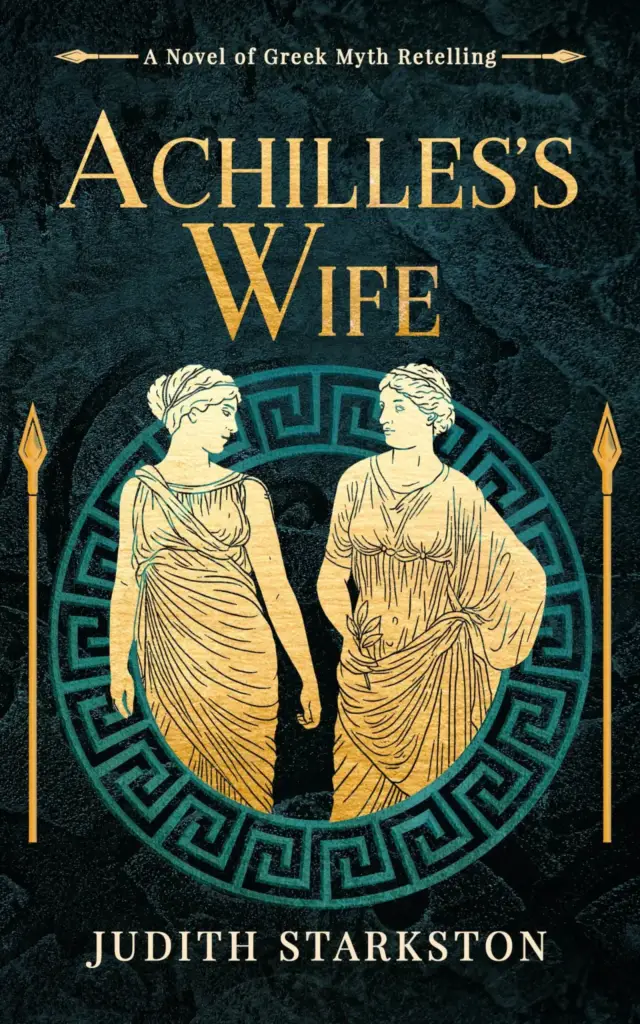
Greek mythology’s most famous stories are so crowded with heroes that everyone else tends to disappear. It was a particular challenge for Christopher Nolan’s take on The Odyssey. King’s rage, warriors sulk, gods meddle, cities burn. Meanwhile, at the edges of the epic, women marry, mourn, give birth, inherit the consequences, and are generally expected to do so without taking up too much papyrus.
Judith Starkston has made a literary career out of wandering into those margins. A classicist as well as a novelist, she is drawn to the places where archaeology, history, and myth cease to agree with one another and imagination must take over. In Achilles’s Wife, part of her Trojan Thread series, she turns her attention to Deidameia, a princess remembered by antiquity largely because Achilles happened to pass through her life.
The episode is one of the stranger detours in the Achilles legend. Thetis, knowing that her son is destined to die if he goes to Troy, hides him on the island of Scyros. According to later versions of the story, Achilles disguises himself as a girl and lives among the daughters of King Lycomedes. Somewhere in the proceedings, Deidameia becomes pregnant. Achilles eventually departs for Troy, and mythology quickly loses interest in her. This is precisely where Judith becomes interested.
She makes one audacious adjustment to the traditional account. Thetis does not merely place Achilles in women’s clothing. She transforms his body into that of a woman. What had survived as an almost comic disguise becomes instead a crisis of identity. Achilles, the young man who will someday become the Greeks’ supreme emblem of masculine prowess, finds himself abruptly estranged from his own body.
The alteration changes everything. Deidameia is no longer a convenient romantic footnote. She becomes Achilles’s confidante and protector, the person who helps him endure a bewildering transformation while trying to understand the secrets surrounding him. Their relationship grows not from conquest but from mutual vulnerability.
It also permits Judith to rescue Achilles from the caricature that centuries of shorthand have made of him. Homer’s Achilles is certainly capable of vanity, cruelty, and catastrophic anger. But he is also capable of tenderness. In the Iliad, he compares his care for the Greeks to that of a mother bird feeding her young. Judith seizes upon such contradictions. Her Achilles can be frightening without being simple.
Yet Achilles’s Wife finally belongs to Deidameia. Judith imagines her not merely as a princess awaiting whatever fate the men around her decide, but as a woman sharing responsibility for the rule of Scyros. Through her, the novel examines an uncomfortable truth about history. Progress rarely travels in a straight line. Women in certain ancient cultures could possess authority or legal standing that women in supposedly more civilized eras would later lose.
This is the peculiar gift of retelling myth. The old stories do not change, exactly. Our angle of vision does.
And so it is with Judith’s assessment of Nolan’s Odyssey. Old stories regularly get updated for new audiences. The bottom line in the movie business is the number of seats sold. The film’s booming business tells us that this truncated iteration of Homer’s epic poem has racked up record revenue. Once again, the tale steps out of the shadows of time and to the front of our consciousness as a story Judith notes has reverberations that echo the issues of our day.
For centuries, Deidameia stood in Achilles’ shadow. Judith Starkston turns the light slightly, and suddenly the shadow has a face, a mind, and a story of her own. Greek mythology has always been populated by extraordinary women. The real question is why it took us so long to ask what they were thinking.