

Hear the Conversation | Get the Book
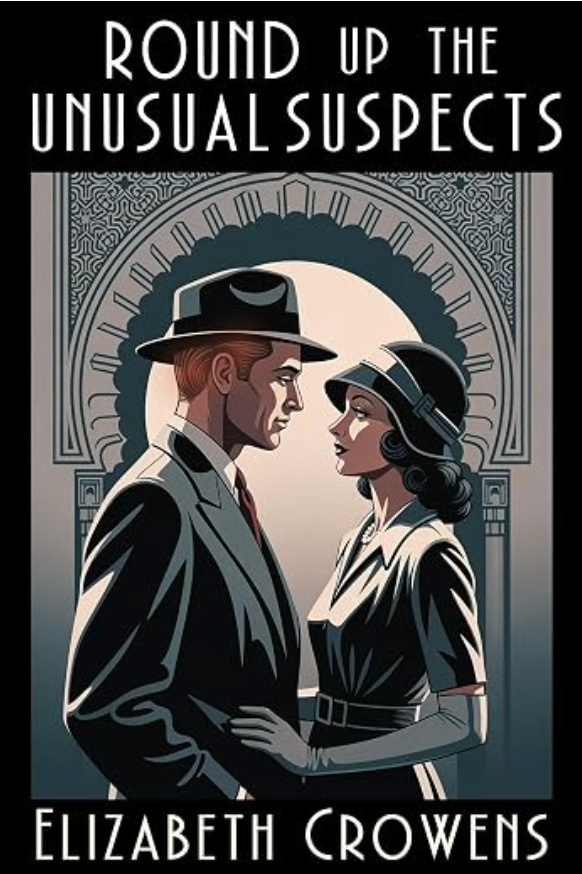
Hollywood has always maintained a flexible relationship with reality. History enters through the studio gates, submits to makeup, and emerges with improved lighting and a more satisfactory ending. Elizabeth Crowens has worked in both the New York and Los Angeles entertainment industries. She understands this process intimately. In her fiction, the past is neither a museum exhibit nor a costume party. It is a crowded workplace filled with temperamental stars, frightened executives, recycled scenery, and people trying to finish the day before somebody gets killed.
Her latest novel, Round Up the Unusual Suspects is the third installment in her classic-Hollywood detective series. Its setting is the Warner Brothers lot in 1942, where “Casablanca” is being assembled from fog, plywood, borrowed sets, and uncertainty. When a stagehand is murdered on the soundstage, Jack L. Warner calls upon private investigators Babs Norman and Guy Brandt. Their assignment is to identify the killer without interrupting production, a reminder that, in Hollywood, death may be tragic, but delays are unforgivable.
Babs and Guy are former actors, though not especially successful ones. Their partnership began in a cemetery, over a lunch composed of food they had not precisely purchased. After protecting Humphrey Bogart during an earlier adventure, they have earned a place in the studio’s unofficial emergency services. This time, they enlist members of the “Casablanca” company in a mystery that gradually expands beyond the usual collection of grudges, affairs, and contractual resentments.
Elizabeth is particularly alert to the ingenuity of wartime filmmaking. The airplane in the movie’s famous final sequence was a small wooden replica. Fog concealed its limitations, while little people were positioned nearby to create the impression of a full-size aircraft. The Paris train station had previously served as part of a desert musical and was transformed with economical changes in decoration. Such details possess the charm of backstage gossip, but they also reveal the central principle of the motion-picture business. If an illusion is sufficiently persuasive, its construction becomes irrelevant.
Still, Elizabeth does not permit nostalgia to soften the period’s harsher edges. Beyond the soundstage, Los Angeles is unsettled by fascist organizations, anti-Semitic intimidation, and the wartime persecution of Japanese Americans. Babs attempts to protect her Japanese gardener from internment, turning public injustice into a private obligation. Guy, meanwhile, confronts the possibility of military service. The glamorous machinery of Hollywood continues operating, but history keeps intruding between takes.
Elizabeth tells me that she treats her invented characters as though they were real. The reverse is also true. Historical figures such as Warner and producer Hal Wallis are allowed their vanity, anxiety, and human inconvenience. When Elizabeth found herself unable to choose a murderer from among her fictional suspects, she wrote their names on index cards, shuffled them, and threw them into the air. It is an eccentric method, though perhaps no more arbitrary than certain studio casting decisions.
Round Up the Unusual Suspects derives its pleasure from the space between the finished movie and the disorder required to create it. “Casablanca” may endure as a polished romance, but Elizabeth Crowens directs our attention toward the edges of the frame, where the scenery trembles, the fog machine sputters, and someone in the darkness is waiting for the cameras to stop.