

Hear the Conversation | Get the Book
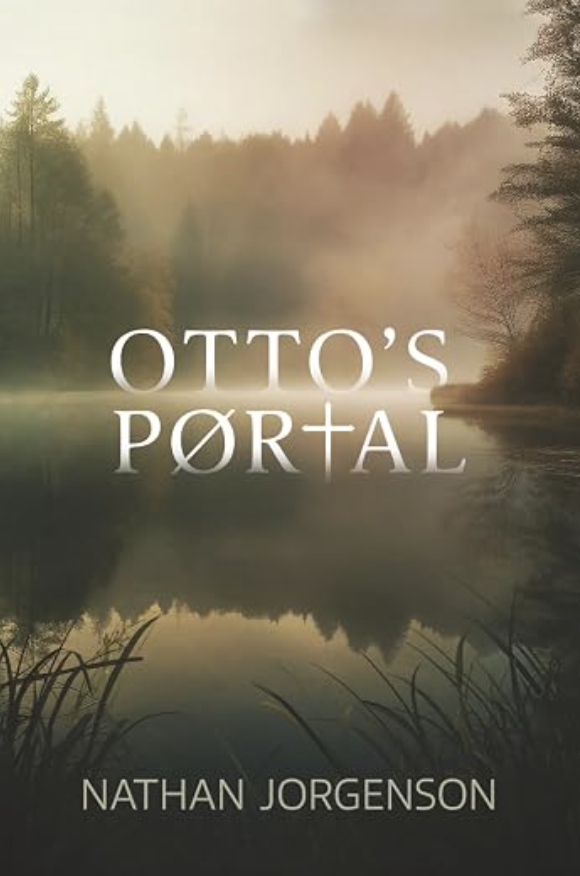
Nathan Jorgenson did not set out to become the sort of novelist who sends readers peering into the afterlife through the surface of a trout stream. He began with dentistry. It’s a profession he describes with the amused claustrophobia of a man who spent too many hours “working through a keyhole,” drilling little holes in little teeth and, as he puts it, thinking little thoughts. Yet it is precisely this narrowing of the world to enamel and nerve, that seems to have sent him looking for larger apertures.
His new novel, Otto’s Portal, begins with a metaphysical: if the soul leaves the body at death, what keeps it attached while we are alive? The premise alone has the pleasing audacity of a midnight radio talk-show, but Nathan’s route into it is more intimate than sensational. The story moves from postwar London to Lyndon Johnson’s ranch to a Catholic church in northern Minnesota, blending science, faith, history, myth, and death itself into a narrative that blurs the lines between fact and conjecture.
Nathan’s own origin story as a writer is less about ambition than grief. He began writing for his dying father, reading to him in a nursing home. He read about two men in a duck boat because that was a world they had shared. When his father died, Nathan kept going, and in the act of finishing the story found both closure and a return to language. The dentist, it turned out, had been a storyteller all along, the man at deer camp who knew how to hold a room. On the page, he discovered how words can remain long after camp is a memory.
Otto’s Portal is animated by that same double vision, the campfire tale and the cosmic question. At its heart is a Catholic priest who believes the surface of a trout stream is the membrane between this world and another. Fish can be seen, touched, even harmed from above, but they cannot cross into our air any more than we can breathe in their water. From that image, Nathan builds a theology of thresholds, one in which the soul is less an abstraction than a force waiting to be measured.
The novel’s aging physicist, Otto Helfritz, imagines a fifth force beyond gravity, electromagnetism, and the nuclear forces. He envisions something that fastens the soul to the body and may also open a passage where none should be opened. Nathan writes at the borderland where history becomes rumor, where science brushes against scripture, where redemption is not preached but pursued by flawed people who have no choice but to keep asking what their lives have meant.
For all its speculative machinery, the book appears rooted in the Northwoods, in memory, failure, hunting camps, fathers, wives, priests, trout streams, and the stories people finally tell when someone is willing to ask. Nathan Jorgenson says he hopes a reader finishes the last page and thinks, “I gotta think about this one for a while.” That is a modest ambition, and a considerable one. In an age that rewards explanation, Otto’s Portal seems built to restore the older pleasure of mystery.