

Hear the Conversation | Get the Book
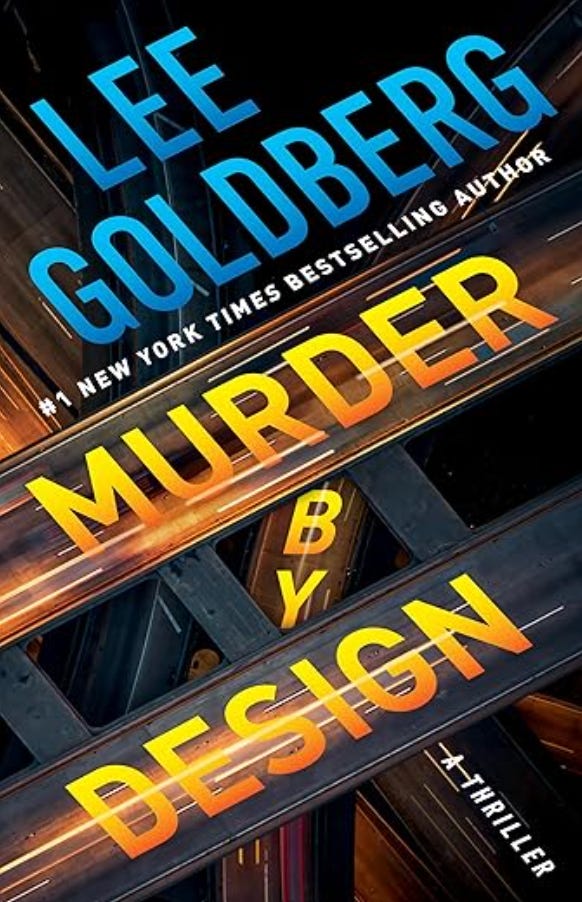
Lee Goldberg has spent much of his career turning murder into an oddly companionable profession. He’s the sort of writer who speaks about craft as if it were both a calling and a chronic illness. His new novel, Murder by Design, launches a fresh mystery series, though “fresh” may be too tidy a word for a book that seems purposefully engineered to scuff the furniture of the classic whodunit.
At the center of the novel is Edison Bixby, a rich, handsome, infuriatingly brilliant man whose gift is not merely noticing what others miss but recognizing how the built world quietly bosses us around. In Bixby’s mind, architecture, lighting, retail layout, landscape design, all the little tyrannies of human arrangement become motive, means, and opportunity. The premise sounds unlikely until Lee begins talking about it, at which point the reader may find himself regarding the nearest shopping mall, airport terminal, or grocery aisle with fresh suspicion.
Bixby is not another trembling genius in a dressing gown. Lee is too well read in the genre to miss the fun in its ancient machinery. Sherlock Holmes, Nero Wolfe, Hercule Poirot, Adrian Monk, these men hover over the book like irritable ancestors. But Bixby is built to offend the lineage. He is wealthy, seductive, stylish, and socially functional, at least until a traumatic brain injury disables the censor between perception and speech. He does not become brilliant because of the injury. He becomes unbearable because of it.
Every eccentric detective needs a witness, and Lee gives Bixby one in Wally Nash. He is a struggling actor hired to serve as social buffer and narrative conscience. Wally is the Watson figure and he knows it’s exactly what he is. That self-awareness gives the book its mischievous charge. Lee is not merely using the formula. He is pointing to the formula while using it, then daring the reader to enjoy it anyway.
What makes Lee Goldberg such a durable entertainer is that he understands structure without worshipping it. His years in television are everywhere in his fiction. He writes books by first writing them as screenplays, not for sale but for himself. It’s his way of getting the story upright and moving. The result is fiction with an unusually clean gait. Scenes arrive with purpose. Dialogue carries load-bearing weight. Exposition is kept on a short leash.
Yet beneath the velocity is a deeper unease. Goldberg jokes about writing from desperation, fear, and terror, but the joke has ballast. He begins with character, not puzzle. The crime grows out of pressure, and pressure reveals character. That is why Murder by Design feels less like the start of a gimmick than the opening of a franchise with room to breathe.
Lee Goldberg’s great trick is to make professional anxiety sound like vaudeville. He says writing keeps him out of therapy, that he is miserable while writing and happy only when he has written. This may be the truest description of the working novelist ever offered by a man surrounded by his own book covers. Lee remains that same kid eating junk food, drinking Diet Coke, listening to soundtracks, and hoping someone will read what he has made.
With Murder by Design, plenty will.