

Hear the Conversation – Get the Book
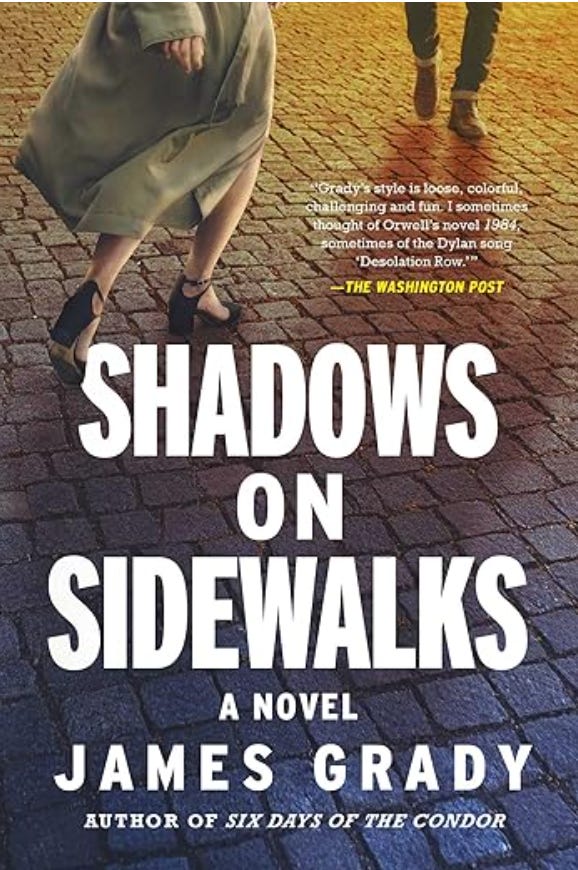
There is something quietly subversive about the career of James Grady. He is a writer who long ago earned the right to repeat himself, as some authors do. Instead, book after book, he interrogates the very machinery of suspense. In Shadows on Sidewalks, his latest novel, James returns not with the grand conspiracies that made his name, but with something more intimate, more unsettling. A homecoming. A reckoning. A reminder that the most dangerous terrain is often the one we think we know best.
The novel centers on James Trayvin, drawn back to his small Montana town by obligation, only to find that the familiar has curdled into something opaque and threatening. It is a premise that might, in lesser hands, settle into nostalgia or melodrama. James resists both. For him, “home” is neither sanctuary nor simple trap, but a living archive. It stores what we remember and, more ominously, what we never understood in the first place.
He speaks of this tension with the curiosity of someone still surprised by his own material. He recalls puzzling over the old admonition that one cannot go home again, only to realize that the deeper truth is not about impossibility but inevitability. We do return, if not physically then psychologically, carrying with us the unresolved fragments of who we were. In Shadows on Sidewalks, that return is accelerated by the mechanics of the thriller. The clock is always ticking, but the pressure comes less from external threat than from the slow revelation of buried histories.
What distinguishes James Grady’s approach is his insistence that suspense is not merely about plot, but about perception. The sidewalk outside one’s front door, he submits, contains more volatility than we notice over breakfast. It is a modest image, almost domestic, yet it captures the novel’s central unease. Danger does not arrive from elsewhere. It is already present, disguised as routine.
The book’s emotional core, however, lies in its characters, particularly Lana LaBuff, a figure shaped by both vulnerability and resolve. Through her, James turns his gaze toward the lived realities of Indigenous women, whose stories of violence and erasure rarely find sustained attention in mainstream thrillers. His research infuses the narrative with a moral gravity that resists exploitation. Lana is not a symbol but a person, and her presence complicates the novel’s shifting balance between erotic tension and psychological dread.
James’ craft, honed over decades, is evident in his pacing, which borrows from the stripped-down clarity of writers like Elmore Leonard. Sentences move with intention. Dialogue arrives as if overheard rather than composed. Yet beneath this apparent simplicity lies a deeper philosophical turn. Where his earlier work often grappled with large political forces, Shadows on Sidewalks is preoccupied with the smaller, more elusive dramas of the human heart. The question is no longer simply what will happen, but who we become when it does.
There is also a note of quiet urgency in the book’s title, often abbreviated as “SOS.” James acknowledges the resonance. He tells me we are living in a moment that invites such signals, a time when the pace of change has outstripped our ability to process it. His characters, like his readers, are forced to confront a difficult truth. Independence is a myth we outgrow. Survival, emotional or otherwise, is communal.
In this sense, Shadows on Sidewalks is less a thriller than a conversation. It asks what we owe to one another, and whether we are willing to admit that we need help at all. James Grady, still restless after all these years, offers no easy answers. Only the uneasy comfort of recognition.