
Hear the Conversation | Get the Book
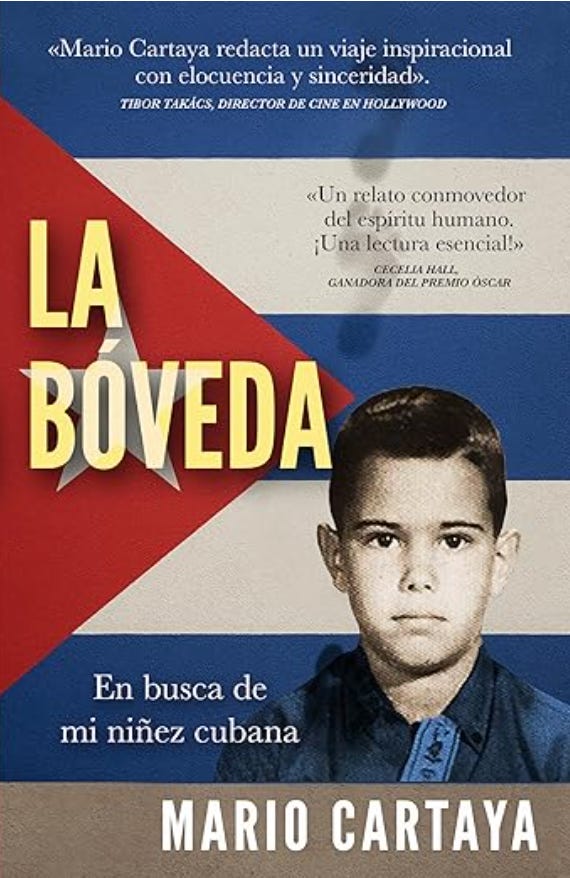
There is a moment, late in Journey Back Into the Vault: In Search of My Faded Cuban Childhood Footprints, when author Mario Cartaya sits on a balcony in Havana and encounters a boy he once was. The scene unfolds as a memory, whole, insistent, and strangely alive.
Mario’s memoir is, on its surface, a story familiar to the American imagination. A child leaves Cuba in 1960 under the shadow of political upheaval, grows up in the United States, learns a new language, absorbs a new culture, and ultimately thrives. He becomes an architect of note, builds a successful firm, and is honored in the country that became his home. Yet the book resists the tidy arc of immigrant triumph. It is less concerned with what was built than with what was buried.
For fifty-six years, Mario lived without access to his earliest memories of Cuba. The departure, abrupt and charged with danger, had triggered what he describes as a kind of psychological vault. His subconscious sealed away the fragments of a childhood too disruptive to carry forward. What remained were stories told by others and a handful of photographs, artifacts without emotional resonance. The past existed, but at a distance, like a country glimpsed only on maps.
The memoir begins when that distance becomes untenable. Hearing Barack Obama speak in Havana, quoting José Martí, Mario feels something shift. The words, simple and luminous, expose a fracture he can no longer ignore. He knows who he has become, he tells me, but not who he has been. And so he returns, not as a tourist or a political observer, but as a man in search of himself.
Cuba, in his telling, is less a place than a condition of time. “A clock that stopped in 1959,” he calls it. The streets, the buildings, even the textures of daily life appear preserved, offering not just reminders but triggers. And with each step, the sealed vault begins to open. Memory does not trickle back. It floods.
What distinguishes Mario’s account is the intensity with which these recovered moments are experienced. Sitting on that balcony, he does not merely remember the day his family decided to flee. He inhabits it. He sees his younger self, feels the same fear, the same confusion. And then, in a gesture both tender and impossible, he tries to reassure the boy. It is only later he realizes the futility of the attempt. The life that frightened child could not imagine has already been lived.
This is the paradox at the heart of the book. The past, once inaccessible, becomes so vivid that it challenges the authority of the present. Mario’s American life, successful and complete, is revealed as partial. Only by reuniting it with the Cuban life he had lost does he achieve a sense of wholeness. He does not return as a Cuban American. He returns, he writes, as both Cuban and American, two identities held not in tension but in harmony.
There is, too, a quieter theme running through the memoir, one that feels almost architectural in its precision. Mario suggests that each of us carries such a vault, a hidden structure of memory and emotion that shapes us without our consent. We may never open it. We may not even know it exists. But it is there, influencing the contours of our lives in ways we only dimly perceive.
To read Journey Back Into the Vault is to be reminded that identity is not a fixed design but an evolving structure, built as much from what we remember as from what we forget. Mario Cartaya’s achievement lies not simply in recovering his past, but in showing how its rediscovery transforms the present. In the end, his journey is less about Cuba than about the fragile, necessary act of becoming whole.
Learn more about Mario Cartaya at MarioCartaya.com.