

Hear the Conversation | Get the Book
In the sun-bleached condominium towers and homeowner associations of South Florida, where neighborly disagreements have a habit of metastasizing into procedural warfare, Gary Fields built a career adjudicating disputes about bylaws, budgets, balconies, and the subtle oppressiveness of shared walls. It is the kind of work that demands patience, diplomacy, and a tolerance for human friction. It is also, as it happens, the kind of work that trains the mind for the long game.
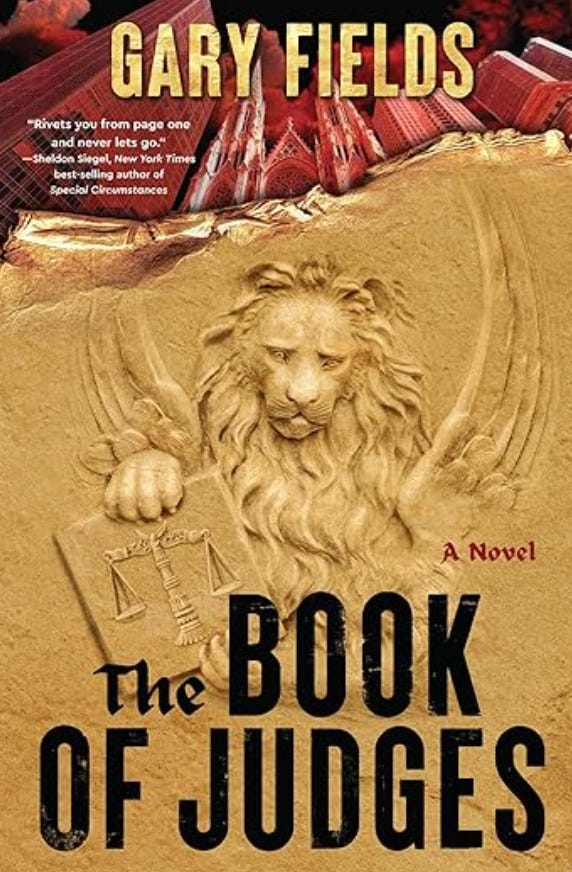
Gary’s first novel, The Book of Judges, is the product of precisely that sort of patience. Though it arrives on bookstore shelves with the tidy label “debut,” the book the culmination of a quiet, twenty-year deliberation. The delay, Fields explains with the calm resignation of someone accustomed to legal continuances, can be attributed to the inescapable factor known simply as life.
His story began two decades ago. Gary had previously worked as a programmer/analyst for several Fortune 500 technology companies before attending the University of Miami’s law school at night. He was married, and still is, to a woman who happened to be reading a historical thriller. After finishing it, she looked up and offered a simple verdict: “You could do this.” Gary, who had spent much of his life navigating both software code and legal codes, did not dismiss the remark. Three days later he had a premise.
Execution, however, proved more of a marathon than a sprint. The manuscript evolved through fifteen drafts, pauses, and detours. A solo law practice had to be built. Children had to be raised. The rhythms of professional life intervened. At one point the book sat untouched for nearly a decade, waiting with the patience of a case file gathering dust. Only later, after Gary retired from legal practice, did the project resume in earnest. He enrolled himself in a kind of informal postgraduate education, devouring writing master classes and submitting to the rigorous attentions of an editor who treated the manuscript with the discipline of a courtroom cross-examination.
The resulting novel is an intricate hybrid of ancient moral inquiry and contemporary technology. In The Book of Judges, the murder of a respected jurist unlocks a chain of clues hidden inside a virus-riddled laptop. What follows is a tightly wound three-day race across Florida, guided by a trio of unlikely collaborators: Josh Sutton, a stubborn young lawyer with technical instincts; Samantha, known as Sammi, a theology doctoral candidate with an intuitive grasp of history and faith; and Mark, a quietly eccentric computer wizard whose talents lie somewhere between hacker and philosopher.
The characters draw liberally from Gary’s own landscape of experience. Josh echoes the author’s own dual identity as lawyer and technologist. Sammi borrows the intellectual curiosity and empathetic instincts of Fields’ wife and daughter. Mark is an affectionate composite of the programmers Gary knew in his earlier career, those brilliant, slightly mysterious figures who seemed to commune with machines in their own private dialect.
What distinguishes the novel, though, is its insistence that the mystery lies not only in circuits and code but also in the recesses of the human mind. Josh and Sammi begin experiencing shared dreams that draw them toward the dilemmas of ancient judges, figures who wrestled with human rights laws in pursuit of something closer to justice.
Gary calls the animating force behind this idea “The Words,” his shorthand for the strange, almost mystical notion that human creativity is evidence of a hidden interconnectedness. Eight historical narratives, stretching across two thousand years, weave through the modern story like faint but persistent echoes.
And yet Gary’s gaze on human rights is not entirely backward. Gary is also preoccupied with the technological future. Influenced by the futurist Ray Kurzweil. Yes, the same Ray Kurzweil musicians honor as the creator of the K250, a keyboard favored by the likes of Stevie Wonder which was among the first to synthesize instruments with such perfection that an orchestra could inhabit 88 keys once solely associated with a piano. Kurzweil imagines a world in which consciousness might one day be digitized, stored, and perhaps manipulated. In that speculative horizon lurks a darker possibility: the emergence of a digital autocrat capable of erasing minds as easily as deleting files.
Still, The Book of Judges’ central concern is not technology but connection. Across centuries and cultures, Gary Fields’ characters struggle toward the same fragile objective: doing the right thing. If the book offers a message, it is that human destiny may be shaped less by the machines we build than by the invisible threads that tie one mind, and one moral choice, to another.