

Hear the Conversation | Get the Book
For thirty-four years, Darlene Dziomba lived comfortably inside those lines at the tax-and-spreadsheet-heavy world of finance at the University of Pennsylvania. It was a life defined by an institutional faith that order, properly maintained, could hold chaos at bay. Yet as any devoted reader of cozy mysteries can attest, the most interesting things rarely happen at the center of a well-ordered page. They occur in the margins, where the rules loosen their grip.
Darlene’s own detour from order did not arrive as a crisis, nor as a dramatic reinvention. It came, instead, at the Bouchercon conference, during a panel discussion with mystery writers. As she listened, she noticed a peculiar sameness in the fictional detectives being described. Many had dogs, and many had dog adjacent professions. Groomers, walkers, sitters. The animals were there for charm and companionship but always removed from the more difficult realities of animal welfare. Few were writing about the gritty, emotionally complex world of rescue shelters. Darlene, who had spent years volunteering in precisely that environment, felt the click of recognition. “I have all this knowledge about shelter operations,” she thought. “I’m going to write that.”
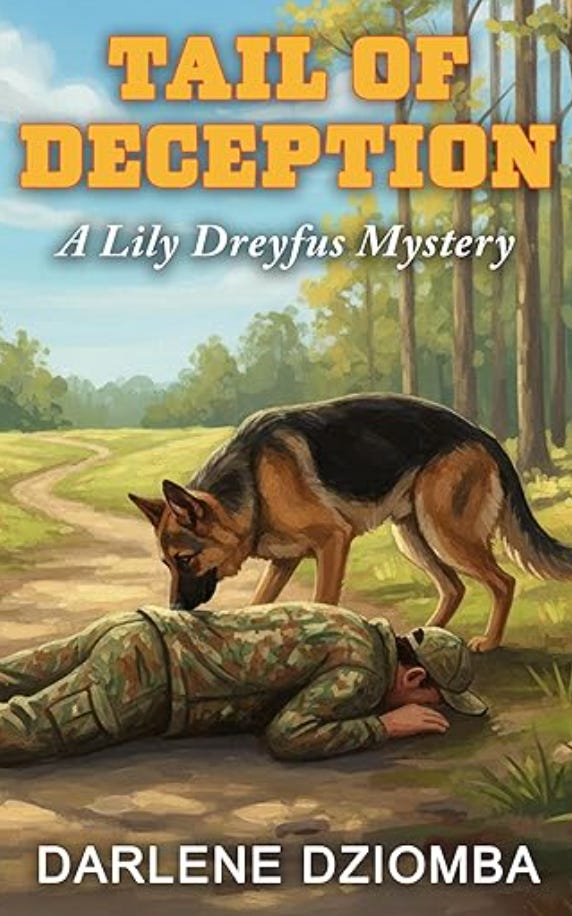
The result was the Lily Dreyfus mystery series. From her home base in New Jersey, the series has found a readership well beyond state lines, drawn by its combination of puzzle solving and animal centered warmth. Her latest installment, Tail of Deception, situates its crime in the annual five K fundraiser for the Forever Friends Animal Shelter. When a former Marine collapses dead at the finish line, part of a team organized by Lily’s boyfriend, Jim, the initial assumption of overexertion quickly gives way to a darker truth. The cause is poison, delivered with intent.
Darlene writes squarely within the cozy tradition, a genre defined less by the absence of death than by the careful management of its emotional consequences. The mystery must be sufficiently intricate to reward attention, but never so bleak that it unsettles the reader’s sense of comfort. “It’s an interesting dichotomy,” she explains. “People read cozy mysteries because they don’t want to sit in darkness.” She gauges this balance through a remarkably physical barometer. When the tension in a scene becomes too sharp, she feels her shoulders inch upward toward her ears. It is her cue to soften the tone, to step back from the edge.
What distinguishes the Lily Dreyfus books from their genre peers is the authenticity of their four-legged cast. The dogs are not props or mascots, but characters endowed with distinct habits, moods, and unspoken opinions. A self-described dog whisperer, Darlene draws directly from her own life. Boone, a beagle basset mix, carries the stubborn streak of her late dog Tugger, named for Phillies pitcher Tug McGraw. Crockett, a terrier mix, mirrors her current companion, Billie. Their behavior is rendered with the easy specificity of long observation.
In Darlene’s telling, animals are often more legible than people. They listen, she says, with a spark of acknowledgment that suggests comprehension, followed by a tilt of the head that implies independent judgment. It is a sensibility that reflects her own temperament. An introvert by inclination, she prefers the behind-the-scenes work of shelter life, scrubbing kennels, arranging adoptions, managing logistics.
If there is a release valve in her fiction, it appears in the construction of her villains. Many, she admits, are modeled on people from her past whom she did not particularly enjoy. Imagining their downfall offers a private satisfaction, a controlled reckoning that remains safely on the page.
Looking ahead, Lily Dreyfus faces challenges less lethal but no less familiar. Moving in with Jim brings the negotiations of a three-dog household, along with the strain of a partner who views amateur sleuthing with skepticism. These domestic tensions unfold against the recognizable backdrop of suburban New Jersey, with its community gardens, seasonal baking rituals, and occasional local news item about marauding turkeys.
Darlene Dziomba’s second life is composed of mystery and maintenance. Her stories contain careful plots and muddy paws, and of course, wagging tails. Like any good story, they insist on being followed wherever they lead.