

Hear the Conversation | Get the Book
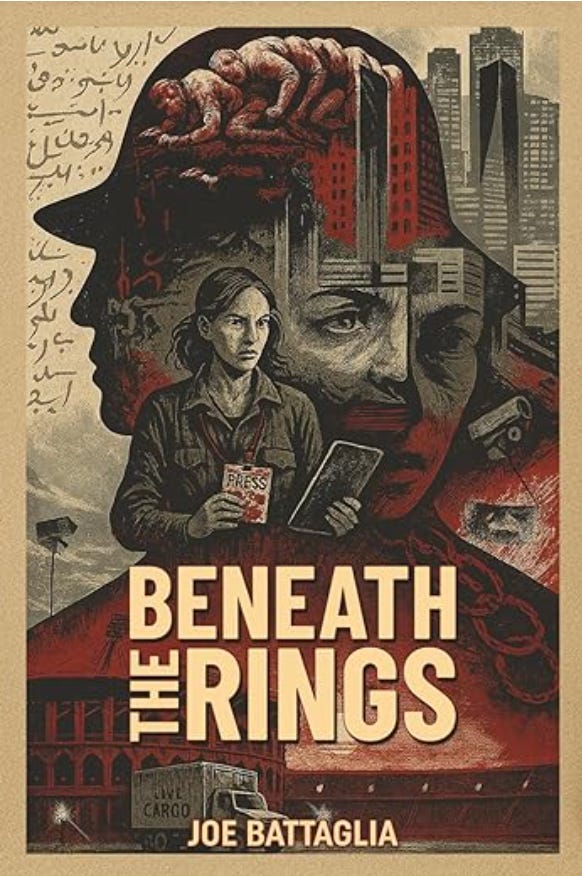
The modern Olympics operate on a kind of global suspension of disbelief. Every two years, billions of viewers are invited to participate in a collective act of idealism. We are shown tableaux of unity, while the Games’ vast political machinery thrums just out of frame. Joe Battaglia has spent much of his adult life inside that machinery. As a journalist and producer for NBC’s Olympic coverage, he chronicled the Games from Beijing’s smog-choked horizon to London’s polished pageantry, witnessing firsthand the dissonance between the myth and the mechanism. With Beneath the Rings, his debut thriller, Joe turns that dissonance into narrative fuel.
The novel imagines a nightmare unspooling on the eve of the 2040 Summer Games in Doha, Qatar, a city Joe chose for its architectural schizophrenia, where the “old town” and the hypermodern skyline exist in awkward proximity. Into this backdrop he introduces catastrophe: twelve athletes vanish, swallowed by a group calling itself the Obsidian Hand. The victims are Israelis and Lebanese, a pairing that feels both improbable and inevitable in a region where history exerts the gravitational pull of a dying star. Joe seems to suggest that the ghosts of Munich have never truly been laid to rest; they merely wander the periphery of every Olympic Village, waiting for someone to acknowledge their presence.
The novel’s plausibility is not accidental. Joe has covered enough opening ceremonies to recall the pointed silences, the booing, the wary glances cast toward delegations bearing the Star of David. “I’ve seen how Israeli athletes are treated in that region,” he told me. The hostility, he notes, is rarely theatrical. Its quietness is what makes it so chilling. In Beneath the Rings, these simmering tensions metastasize into a kidnapping executed with surgical precision by a collective Joe describes as a “twisted A-Team.” Their cruelty is not sensationalized but procedural, a recognition that real terror is often engineered, not improvised.
Guiding the reader through this labyrinth is Nova Mendelssohn, a veteran journalist whose instincts are honed by decades spent interrogating institutions reluctant to be examined. Joe built her from the DNA of the profession’s great women: the unflinching scrutiny of Ida Tarbell, the battlefield tenacity of Lara Logan, the relentless clarity of Helene Elliott and Leslie Visser. Mendelssohn is not a superhero; she is a reporter who refuses to accept the quietist doctrine of the International Olympic Committee, an organization whose talent for silence often surpasses its talent for governance. In Joe’s telling, the truth is not merely a virtue but a form of dissent.
That Joe would produce a geopolitical thriller of this magnitude is, at first glance, a peculiar turn for a writer whose entry into the business was a self-published children’s alphabet of track-and-field icons, what he calls a “boredom project” born of a layoff. But the seeds of this darker imagination were planted early. A Newark native who landed at the Star-Ledger at eighteen, Joe’s formative moment came in 2007, while he was coordinating coverage of the U.S. Olympic Trials men’s marathon. In the middle of the event, runner Ryan Shay collapsed and died. The experience, he recalls, was a kind of initiation, an abrupt lesson in the precariousness that undergirds even the most orderly institutions.
Beneath the Rings draws on that sense of precariousness. It is, in some ways, a refinement of the impulses that drove Joe as a boy hammering out a Vatican-infiltration caper on a Commodore 64, a desire to probe the sanctity of revered institutions, to imagine what trouble might slip through their ornamental gates. This new novel is tempered by experience, by the knowledge that real chaos is rarely operatic.
The book has drawn early praise for its pace, its tension, its unsettling proximity to plausibility. Joe Battaglia is no longer the observer cataloguing someone else’s performance. He is the athlete on the line, waiting for the judges to hold up their scores. What he has produced is a reminder that the Olympic flame, for all its symbolism, burns against a backdrop of complex landscapes and dark geopolitical fault lines. The brighter the torch, the more sharply the shadows fall.